
One Dark Front Tooth: Why It Happens and What Can Be Done
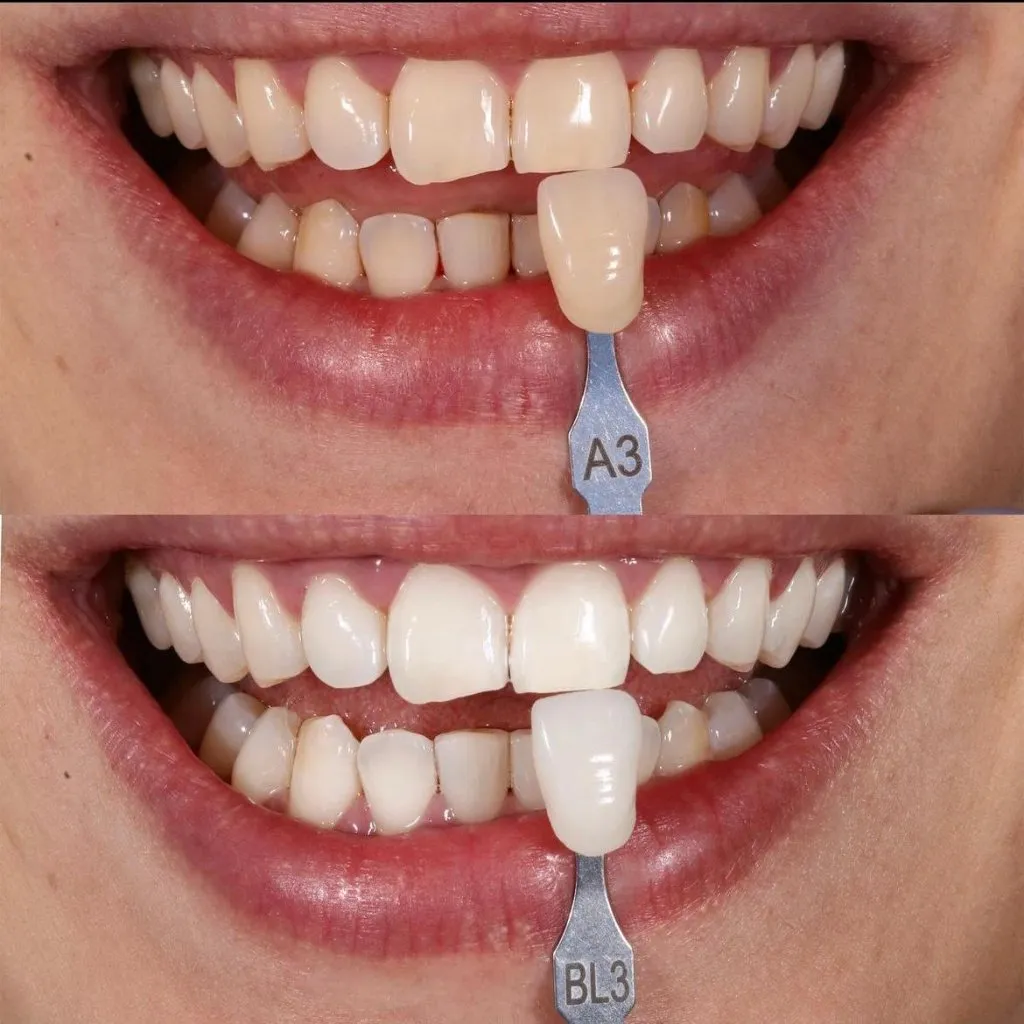
When one front tooth turns grey, brown or darker than its neighbours, the cause is usually inside the tooth: the nerve has died, often years after a knock, or an old root filling has stained it. Ordinary whitening works from the outside and rarely evens out a single dark tooth. The real options are bleaching from inside the tooth, a veneer or a crown, and the first step is an X-ray to check the root, because a dark tooth can be an infected one.
Why does one tooth turn dark when the others do not?
Stains from coffee, tea or smoking affect all teeth roughly evenly. A single dark tooth points to something that happened to that tooth alone. The common causes are these.
| Likely cause | What it looks like | First step |
|---|---|---|
| Nerve died after an old injury | Grey or bluish tooth, often years later | X-ray to check the root and nerve |
| Old root canal treatment | Brown or grey tooth, sometimes darker at the neck | Check the root filling, then consider internal bleaching |
| Old filling showing through | Dark patch or edge rather than the whole tooth | Replace the filling or bonding |
| Decay behind or under a filling | Dark shadow, sometimes with sensitivity | Examination; treat the decay |
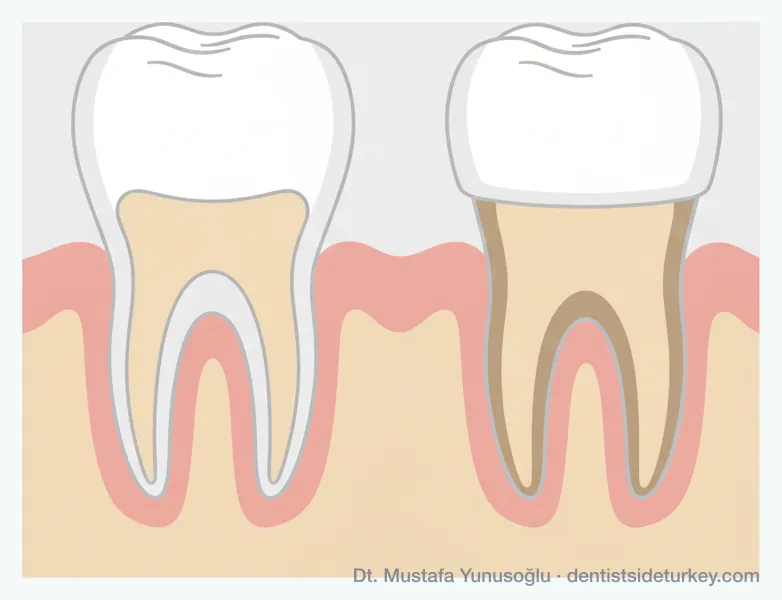
| Old crown with a metal core | Grey edge at the gum or a dull crown | Consider a new all-ceramic crown |
The first row is the most common in adults. A meta-analysis estimated that about 15.2% of people have injured a permanent tooth at some point; many do not even remember the knock, but the nerve can die slowly and the tooth darken years later.
Is a dark tooth a problem, or only cosmetic?
It can be either, which is why the X-ray comes first. A tooth whose nerve has died can stay quiet for years, or it can develop an infection at the root tip, sometimes without pain. If the X-ray shows infection or a nerve that has died, the tooth needs root canal treatment before anything is done about the colour. If the root is healthy and already treated, the question is purely how to match the tooth to its neighbours.
That order matters for honesty too. Covering a dark tooth with a veneer without checking the root may look good on the day and fail when the infection underneath flares up.
Why does normal whitening rarely fix a single dark tooth?
Because the colour is coming from inside. External whitening lightens all the natural teeth it touches, so the dark tooth gets lighter, but so do its neighbours, and the difference often stays. Fillings, crowns and veneers do not change colour at all. Whitening still has a place: if all your teeth are a little yellow and one is much darker, whitening the whole smile first and then treating the dark tooth to match gives the best result. Our guide to teeth whitening covers the session, and our post on choosing a shade explains how a target colour is chosen.
What are the options for the dark tooth itself?
Three, in order of how much tooth they remove.
Internal bleaching. For a tooth that already has a root canal, a whitening agent can be placed inside the tooth and sealed for a few days, sometimes repeated. A systematic review of 8 studies found an average change of about six shade-guide units, which is a visible difference, though long-term colour stability has been studied less. It keeps the tooth's own surface and removes nothing from the outside. Internal bleaching is done at our clinic; whether it suits your tooth is decided at the examination.
A veneer. A thin porcelain or composite facing bonded to the front. Very dark teeth are harder to mask with a thin veneer, because the colour can show through, so the material and thickness are chosen for the tooth. A review in the British Dental Journal describes matching a single discoloured tooth as one of the harder tasks in aesthetic dentistry, and that is true: one tooth has to match its neighbours in colour, translucency and surface, with nothing similar beside it to blend into.
A crown. Covers the whole tooth and masks even very dark colour, at the cost of removing more tooth. It is usually the choice when the tooth is also weakened by a large filling or a root canal. How much each option removes is set out in veneers, crowns or bonding.
How is one tooth matched to the others during a stay in Side?
Carefully, and with your eyes as well as ours. Shade is taken in daylight and checked against your other teeth, photos are taken, and the laboratory works from them. Veneers and crowns take a stay of 5‑7 days with two appointments; the temporary at the first appointment also lets you see the shape. At the fitting, the colour is judged before anything is bonded, and if it is not right, it is not fitted. Keep the last day before your flight free for a final look in different light.
If you want to know which option fits your tooth, send photos on WhatsApp, in daylight and without flash, and an X-ray if you have one. Dt. Mustafa Yunusoğlu reviews them personally and a written plan comes back within 24 hours.
When is it better to wait or do less?
When the tooth is only slightly darker and the root is healthy, doing nothing is a fair choice; many people stop noticing a small difference once they know the tooth is healthy. If the tooth darkened recently after a knock, it is sometimes worth waiting and checking again, because a tooth can recover some colour as it settles. And if the dark tooth was chipped as well, our post on a chipped or broken front tooth covers the repair side. Crowns and veneers carry a written guarantee of 5 years.
The contact page has every way to reach us. Results vary from person to person and depend on the examination.
Frequently Asked Questions
Why has one of my front teeth gone dark?
Usually because of something inside that tooth: the nerve has died, often years after a knock, or an old root filling has stained it. Less often an old filling or decay shows through. An X-ray is the first step to find out which, and to check the root for infection.
Is a grey tooth dead?
Often, but not always. A grey or bluish tooth after an old injury is a common sign that the nerve has died. An X-ray and tests show whether the nerve is alive and whether there is infection at the root tip that needs root canal treatment.
Can teeth whitening fix one dark tooth?
Rarely on its own. External whitening lightens all natural teeth together, so the difference often stays. A dark tooth with a root canal can sometimes be bleached from inside; otherwise a veneer or crown is used. Whitening the other teeth first can help the final match.
What is internal bleaching?
For a tooth that has already had a root canal, a whitening agent is placed inside the tooth and sealed for a few days, sometimes repeated. A systematic review of 8 studies found an average change of about six shade-guide units. Internal bleaching is done at our clinic; whether it suits your tooth is decided at the examination.
Veneer or crown for a dark front tooth?
A veneer removes less tooth but can let a very dark colour show through; a crown masks even very dark teeth and is usually chosen when the tooth is also weakened by a large filling or a root canal. The choice depends on the tooth's colour and strength.
How long does it take to fix a dark tooth in Side?
A veneer or crown takes a stay of 5‑7 days with two appointments. If the tooth needs root canal treatment first, that usually adds one or two appointments within the same stay. Internal bleaching, where suitable, needs a few days between visits.
Is it hard to match one tooth to the others?
Yes, it is one of the harder tasks in aesthetic dentistry, because a single tooth must match its neighbours in colour, translucency and surface. Shade is taken in daylight, checked at the fitting, and nothing is bonded until the colour is right.
Sources
- Frank et al. (2022), J Endod: Bleaching efficacy of agents for internal bleaching, systematic review and meta-analysis
- Petti et al. (2018), Dent Traumatol: World traumatic dental injury prevalence and incidence, a meta-analysis
- Aljanahi et al. (2025), Br Dent J: Challenges faced when masking a single discoloured tooth, Part 1
- Oral Health Foundation: Tooth whitening
- Oral Health Foundation: Veneers