
Root Canal or Extraction? When to Save the Tooth and When an Implant Is the Better Choice

If a tooth can be saved with a root canal and a crown, saving it is usually the better first choice: it keeps your own root, fits into one stay and leaves the implant option open for later. Extraction and an implant become the better choice when the tooth is cracked through the root, too broken down to rebuild, or loose from bone loss. Which side of that line your tooth is on is decided by an examination and X-ray, not by a price list.
When is saving the tooth better, and when is an implant?
Most people asking this question have a painful or broken tooth and someone has just mentioned both options. The table shows the factors that usually decide it.
| Situation | Usually better | Why |
|---|---|---|
| Inflamed or dead nerve, solid tooth | Root canal and crown | Your own root stays; good long-term survival |
| Large old filling, enough tooth to rebuild | Root canal, build-up and crown | The crown protects what is left |
| Crack running down into the root | Extraction, then implant or bridge | A cracked root cannot be sealed reliably |
| Very little tooth left above the gum | Often extraction | Not enough to hold a crown |
| Tooth loose from advanced gum disease | Usually extraction, gums treated first | The support has gone, not just the nerve |
| Failed root canal on a solid tooth | Retreatment or extraction, case by case | Depends on the cause and access |
Notice that none of these rows is about which option looks more modern. Implants are excellent, but an implant replaces a tooth you have lost, and a tooth that can be kept is worth keeping.
What do the studies say about each option?
Both work well, which is why the decision depends on the tooth. A systematic review of 14 studies found that teeth treated with a root canal survived in 86% of cases at two to three years, 93% at four to five years and 87% at eight to ten years. The single factor that helped most was a crown placed after treatment, which is why a back tooth with a root canal is usually crowned.
A 2017 systematic review of 60 articles compared root canal treatment with extraction and implant placement. Implant survival figures looked higher than the success figures of tooth-saving treatments, but these measure different things, and in studies that compared the two directly there was no important difference until at least eight years. The authors call both valid and complementary options. In practice, a saved tooth that later fails can still be replaced by an implant; the reverse is not possible.
How does each option fit into a trip to Side?
This is where the two differ most for someone travelling. A root canal is done under local anaesthetic and usually takes one or two appointments, depending on the tooth; the root canal treatment page describes it. If the tooth then needs a crown, that takes a stay of 5‑7 days with two appointments. In most cases, the whole thing fits into one visit.
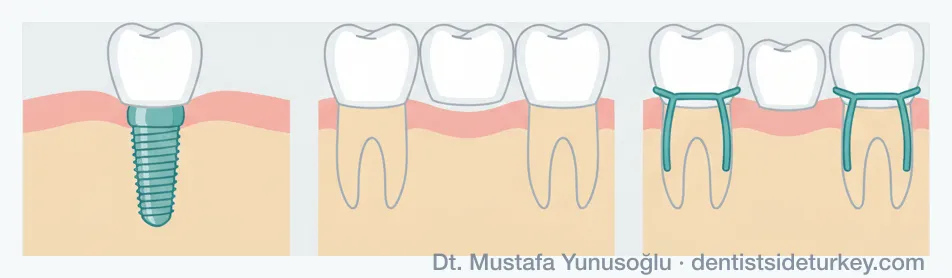
An implant needs two visits. The tooth is removed and the implant placed, sometimes in the same appointment and sometimes after the socket has healed; then the implant joins the bone over 2‑4 months at home, up to 6 in the upper jaw, before the final crown is made on a second trip. The dental implants page shows both visits. If a second journey is not realistic, a bridge is another way to replace a lost tooth in one visit, at the cost of preparing the neighbouring teeth; our post on implant, bridge or denture sets out that trade.
If the tooth started hurting while you are already on holiday nearby, our guide to a root canal on holiday explains what can be done in the days you have left.
How is the decision actually made?
With an X-ray and an examination, and with you in the conversation. The dentist looks at whether the root is cracked, how much tooth is left above the gum, how much bone surrounds the root, and whether there is infection at the tip. Those four things decide most cases. Photos help to plan, but they cannot show a crack in a root or the bone around it, so a remote opinion on this question is always provisional.
If you have been told a tooth must come out and you want to know whether it could be saved, send your X-ray on WhatsApp. Dt. Mustafa Yunusoğlu reviews it personally and a written reply comes within 24 hours. Our post on getting a second opinion explains how much a remote review can tell you.

When is extraction the honest answer?
When saving the tooth would mean spending time and money on something with a poor outlook. A vertical root fracture, a tooth broken down to the gum, or a tooth that has lost most of its bone support are the classic cases. Keeping such a tooth often leads to repeated problems and, eventually, the extraction anyway, sometimes with more bone lost in the meantime. In those cases, removing it cleanly and planning the replacement is the kinder plan.
Extraction is also reasonable if a back tooth has no opposing tooth and no function, and you would not replace it in any case; our post on a missing back tooth discusses when a gap matters and when it does not.
What should you ask before deciding?
Ask what the outlook for the tooth is if it is saved, and why. Ask whether a crown will be needed afterwards and when. Ask, if extraction is advised, what the replacement options are and how many visits each takes. And ask to see the X-ray: a good explanation points at it. The NHS and the Oral Health Foundation describe root canal treatment in plain terms if you want to read more first.
The contact page has every way to reach us. Results vary from person to person and depend on the examination.
Already had a root canal and the tooth hurts again? See retreatment, surgery or extraction.
Frequently Asked Questions
Is it better to have a root canal or pull the tooth?
If the tooth can be saved with a root canal and a crown, saving it is usually the better first choice: your own root stays, it often fits into one stay, and an implant remains possible later. Extraction is better when the root is cracked, too little tooth is left to rebuild, or the tooth is loose from bone loss.
How long does a tooth last after a root canal?
A systematic review of 14 studies found tooth survival of 86% at 2‑3 years, 93% at 4‑5 years and 87% at 8‑10 years after root canal treatment. A crown placed afterwards was the factor that improved survival most.
Are implants better than root canals?
Not as a rule. A 2017 systematic review found no important difference between the two in comparative studies until at least eight years and called them complementary options. An implant replaces a tooth that cannot be kept; a tooth that can be kept is usually worth keeping.
How many appointments does a root canal take?
At Dentist Side Turkey it is done under local anaesthetic and usually takes one or two appointments, depending on the tooth. If a crown is needed afterwards, that takes a stay of 5‑7 days with two appointments.
How many trips does an implant need?
Two. The first visit is for extraction and placement, then the implant heals at home for 2‑4 months, up to 6 in the upper jaw, and the final crown is made on the second visit. A bridge can replace a tooth in one visit if a second trip is not realistic.
Can a tooth with a failed root canal be saved?
Sometimes. Depending on why it failed and whether the root is intact, retreatment can be an option; if the root is cracked or too little tooth remains, extraction is usually better. This is decided with an X-ray and examination.
Can you tell from an X-ray whether my tooth can be saved?
An X-ray shows a great deal, including bone level and infection at the root tip, and lets us give a provisional opinion within 24 hours. A crack in the root or the exact amount of healthy tooth is confirmed at the examination.
Sources
- Chércoles-Ruiz et al. (2017), J Endod: Endodontics versus tooth extraction and implant placement, systematic review
- Ng et al. (2010), Int Endod J: Tooth survival following non-surgical root canal treatment, systematic review
- NHS: Root canal treatment
- Oral Health Foundation: Root canal treatment
- ADA MouthHealthy: Extractions