
Root Canal on Holiday in Turkey: Can You Finish It Before You Fly Home?

Root canal treatment can be started during your holiday, is done under local anaesthetic, and in research the pain falls steeply in the week after it. Whether you can finish it, crown included, before you fly home depends on the tooth and on how many days you have left. The dentist tells you after an examination and X-ray, and a sealed tooth with a written plan is the safe fallback. Swelling that spreads towards the eye or neck, or makes breathing or swallowing hard, is a hospital matter, not a dental appointment.
How many days do you have left, and what is realistic?
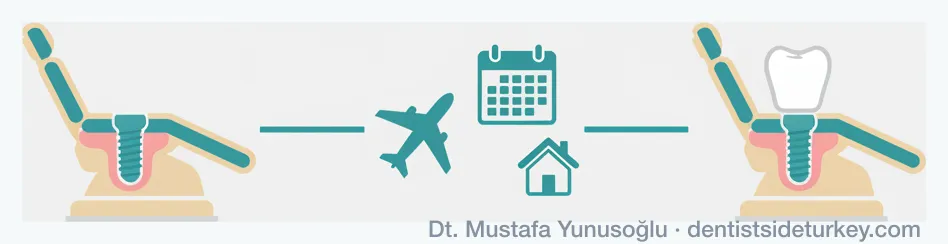
A root canal and the crown that usually follows on a back tooth are two separate jobs. The root canal takes one or two appointments, depending on the tooth. A crown takes two visits over 5‑7 days. This is how that maps onto your stay, as a general guide; the dentist decides after the X-ray.
| Days left | Realistic plan | What you take home |
|---|---|---|
| 1‑2 days | Pain relief first. Where one appointment is enough, the root canal can be finished; if the tooth needs more, it is dressed and sealed, and the dentist says plainly whether to finish at home | A sealed tooth and a written treatment plan for your own dentist |
| 3‑5 days | The root canal in one or two appointments, timed around your flight. The crown, at 5‑7 days, usually does not fit | A finished root filling, with the crown planned for home or a later visit |
| 6‑9 days | The root canal, and sometimes the crown in the same stay, if the tooth settles and the X-ray allows it | Either a finished tooth or a protected one with a clear next step |
| 10 days or more | Room for the root canal, the crown and a check between the steps | A finished tooth, with a written guarantee of 5 years on the crown |
How do you know the nerve is involved?
The usual signs are an ache that lingers for minutes after something hot or cold, throbbing that starts or worsens at night, pain when you bite on one tooth, a tooth that has turned darker than its neighbours, and a pimple or swelling on the gum beside it. Pain that suddenly stops on its own can mean the nerve has died rather than healed.
Only an examination and an X-ray can confirm it. The NHS advice is to see a dentist if toothache lasts more than two days, does not respond to painkillers, or comes with pain on biting or a swollen cheek or jaw. On holiday near Side, our emergency dentist page explains how to reach us.
Does a root canal hurt, and what about afterwards?
The treatment itself should not. The tooth is numbed first, and you should feel pressure and vibration rather than pain. Say so if anything hurts; more anaesthetic can be given.
A review of 72 studies put numbers on this. On average, 81% of patients had pain before treatment, 40% in the first 24 hours after it, and 11% after one week. Expect the tooth to be tender to bite on for a few days, and take the painkiller your dentist recommends.
One appointment or two, and why?
It depends on the tooth. A front tooth has fewer canals and is quicker. A back tooth has more canals and takes longer. A tooth with an abscess may be dressed with a medicine and sealed first, then finished at a second appointment once it has settled.
Neither plan is the better one. A Cochrane review of 25 trials with 3,780 people found no evidence that single-visit treatment beats multiple visits, and single-visit treatment tended to bring more pain in the first week and more painkiller use. So a second appointment is not a sign of poor work. On a holiday, it is timed around your dates, and the days between are covered by a sealed tooth. Our guide to temporary teeth during treatment shows what that looks like.

Why does a back tooth usually need a crown afterwards?
Removing the nerve leaves the tooth more brittle, and a molar takes the heaviest chewing forces. In a study of 203 root-filled teeth followed for years, teeth that were not crowned afterwards were lost at six times the rate of crowned teeth. A review of 14 studies found 86% to 93% of root-treated teeth surviving over two to ten years, and a crown was the factor most strongly linked to survival. Both are observational, so they show an association rather than proof, but the pattern is consistent.
A front tooth with most of its structure intact can often be filled instead. The dentist tells you which applies. A crown here takes two visits over 5‑7 days and carries a written guarantee of 5 years. If the crown has to wait until you are home, protect the sealed tooth meanwhile: chew on the other side and avoid hard or sticky food.
Can you fly, swim and eat after a root canal?
Flying: usually fine once the tooth is sealed, but give the dentist your flight date before treatment starts. A tooth that is still open, dressed or infected can hurt as cabin pressure changes, so the plan is built around your flight.
Swimming: a root canal leaves no open wound like an extraction does, so the sea and pool are fine once the numbness has gone, unless your dentist says otherwise.
Eating: wait until the numbness has worn off, which can take several hours, so you do not bite your cheek or tongue. Keep to soft food that day, and chew on the other side until the final filling or crown is in.
Root canal, extraction or implant?
A tooth that can be saved is usually worth saving. A root-treated and crowned tooth keeps your own root and needs no months of healing. Extraction is quicker, but an implant to fill the gap means two trips with 2‑4 months of healing between them, up to 6 months in the upper jaw. Pulling the tooth is the right call when it is cracked below the gum or too broken down to hold a crown. The X-ray decides, and you get both options in writing. The choices are compared in implant, bridge or denture.
When is the clinic route not the right choice?
Go to a hospital emergency department if toothache comes with swelling around the eye or neck, or swelling in the mouth or neck that makes it hard to breathe, swallow or speak. A high temperature with a swollen cheek or jaw needs a dentist the same day, and a hospital if the swelling spreads.
Wait until you are home if you fly tomorrow and the tooth is only sensitive, with no lingering ache, no swelling and no pain on biting. A calm check and X-ray at home is then reasonable, and you can ask us for a written assessment to take with you. Also check what your travel insurance policy covers abroad before you start; do not assume.
If you are unsure, send a photo on WhatsApp, say how many days you have and what the tooth does, and a person reads it at any hour. The chairs run Monday to Saturday, 09:00 to 19:00, and the clinic is 5‑25 minutes by car from the hotel areas, as set out on dentist near your hotel in Side. For the wider question of time, see how many days dental treatment takes, and the contact page lists every way to reach us. Results depend on the individual case and the examination.
Frequently Asked Questions
How do I know if I need a root canal?
Typical signs are an ache that lingers after hot or cold, throbbing at night, pain when you bite, a tooth that has darkened, or a pimple or swelling on the gum beside it. Pain that suddenly stops can mean the nerve has died. Only an examination and an X-ray can confirm it.
Does a root canal hurt?
The treatment is done under local anaesthetic, so you should feel pressure rather than pain, and more anaesthetic can be given if anything hurts. A review of 72 studies found that on average 81% of patients had pain before treatment, 40% in the first 24 hours after it and 11% after one week.
Can a root canal be finished during a holiday?
Often the root canal can, because it takes one or two appointments depending on the tooth. The crown that usually follows on a back tooth takes two visits over 5‑7 days, so it depends on your days left. If it does not fit, the tooth is sealed and you take a written plan home.
Why does a root canal sometimes need two appointments?
A back tooth has more canals, and a tooth with an abscess may be dressed and sealed to settle before it is finished. A Cochrane review of 25 trials found no evidence that one visit is better than several, and single-visit treatment tended to bring more pain in the first week.
Do I need a crown after a root canal?
Usually on a back tooth, not always on a front one. In one study, root-filled teeth that were not crowned were lost at six times the rate of crowned teeth. A crown here takes two visits over 5‑7 days and carries a written guarantee of 5 years.
Can I fly, swim and eat normally after a root canal?
Flying is usually fine once the tooth is sealed, but tell the dentist your flight date first. Swimming is fine once the numbness has gone, unless told otherwise. Wait for the numbness to wear off before eating, then keep to soft food and chew on the other side until the final filling or crown is in.
Should I have a root canal or pull the tooth?
A tooth that can be saved is usually worth saving. Extraction is quicker, but an implant means two trips with 2‑4 months of healing between them. Pulling is right when the tooth is cracked below the gum or too broken to hold a crown; the X-ray decides, and you get both options in writing.
Sources
- Pak & White (2011), J Endod: Pain prevalence and severity before, during, and after root canal treatment: a systematic review
- Manfredi et al. (2016), Cochrane Database Syst Rev: Single versus multiple visits for endodontic treatment of permanent teeth
- Aquilino & Caplan (2002), J Prosthet Dent: Relationship between crown placement and the survival of endodontically treated teeth
- Ng et al. (2010), Int Endod J: Tooth survival following non-surgical root canal treatment: a systematic review of the literature
- NHS: Root canal treatment
- NHS: Toothache