
Implant, Bridge or Denture in Turkey? How to Replace a Missing Tooth
If the teeth next to the gap are healthy, an implant is usually the better long-term answer, because nothing has to be ground down to carry it. If those teeth already have large fillings or crowns, if surgery is not a good idea for you, or if you cannot come back for a second visit, a bridge is a sound choice and is finished in one week. A removable denture costs least and asks least of your teeth, but it is the option people are least happy living with.
The short answer: three ways to close a gap
| Dental implant | Fixed bridge | Removable partial denture | |
|---|---|---|---|
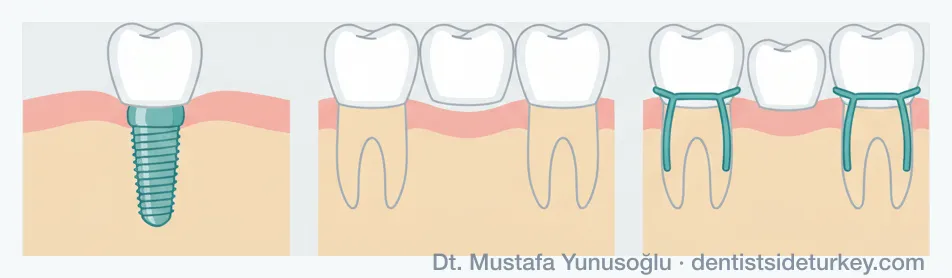
| What it is | A titanium root in the jaw with a crown on top | Crowns on the two neighbouring teeth with a false tooth between them | A plate with false teeth, held by clasps |
| Neighbouring teeth | Untouched | Both ground down for crowns | Not ground, but loaded by the clasps |
| Surgery | Yes, minor, under local anaesthetic | No | No |
| Jawbone under the gap | Stays in use | Slowly shrinks | Shrinks |
| Time in Side | Two visits: 3‑5 days, then 4‑7 days after 2‑4 months of healing | One visit of 5‑7 days | One visit; ask us for the schedule |
| Feels like | Your own tooth | Your own teeth; needs a special floss underneath | A removable appliance |
| Written guarantee with us | 10 years on the implant | 5 years on crowns | Ask with your plan |
What actually happens if you leave the gap?
A gap is not a stable situation. The teeth on either side slowly tip into the space, the tooth above or below grows out of its socket because nothing bites against it, and the jawbone where the root used to be thins out because it is no longer loaded. None of this happens in a month, but after a few years the gap is harder and more expensive to restore than it was on the day the tooth came out.
There is one honest exception. A missing last molar, right at the back, does not always need replacing; many people chew perfectly well without it. If that is your gap, ask before you pay for anything.
How does an implant work, and what does it ask of you?
An implant is a small titanium screw placed in the jaw where the root used to be. Over the following months the bone grows onto its surface, and a crown is then fixed to it. It is the only option that replaces the root, which is why it is the only one that keeps the bone in use and leaves the neighbouring teeth completely alone.
What it asks of you is time and a small operation. Placement takes 30 to 60 minutes under local anaesthetic and is carried out by a dental surgeon specialising in implantology. The first visit to Side is 3‑5 days. The implant then heals for 2‑4 months, up to 6 months in the upper jaw, and a second visit of 4‑7 days fits the final crown. We use Nobel Biocare and Straumann implants, and the implant carries a written guarantee of 10 years. The dental implants page sets out both visits.
It also asks for enough bone and reasonable general health. Heavy smoking, poorly controlled diabetes and untreated gum disease all raise the risk of failure; our guide to implants with smoking, diabetes or gum disease goes through each one.
How does a bridge work, and what does it cost the neighbouring teeth?
A bridge is three or more crowns joined in a row. The two outer crowns are cemented onto the teeth either side of the gap, and the false tooth between them sits on the gum. There is no surgery and no healing period: the teeth are prepared, you wear a temporary bridge for a few days, and the final bridge is cemented within one visit of 5‑7 days.
The cost is paid by the two neighbouring teeth. Each is reduced on every side to take a crown, which in a laboratory study removed about 63‑72% of the visible tooth. If those teeth were healthy, that is a high price for closing one gap. A crowned tooth also carries a small long-term risk of needing root canal treatment, and if decay starts under one end of the bridge, the whole bridge usually has to be replaced. Cleaning matters more than with an implant: a bridge needs a floss threader or an interdental brush under the false tooth every day.
When is a bridge the better choice?
- The neighbouring teeth already have large fillings or old crowns. They would benefit from new crowns anyway, so the bridge costs them nothing extra.
- Surgery is not advisable. Some medical conditions and medicines make implant surgery a poor idea; your own doctor's advice comes first.
- There is too little bone and you do not want a bone graft.
- You cannot make a second trip. A bridge is finished in one week. An implant is not, and nobody should promise you otherwise for a single tooth.
- You smoke heavily and do not plan to stop. Implants fail about twice as often in smokers. A bridge does not care.
When is an implant the better choice?
- The neighbouring teeth are healthy. Grinding down two sound teeth to replace one is the main argument against a bridge.
- You are young. Every restoration is replaced eventually. A bridge that fails at fifty can take a neighbouring tooth with it; an implant crown that wears out is simply replaced on the same implant.
- The gap is at the end of the row. A bridge needs a tooth on both sides. With no tooth behind the gap, the choice is an implant or a removable denture.
- Several teeth in a row are missing. Two implants can carry a fixed bridge of three or four teeth, so you rarely need one implant per tooth.
Which lasts longer?
Less differently than most websites claim. A systematic review by Pjetursson and colleagues pooled the long-term studies: after five years 93.8% of conventional bridges and 94.5% of implant-supported crowns were still in service, and after ten years 89.2% and 89.4%. A separate review found that the implants themselves, as opposed to the crowns on them, survived in 97.2% of cases at five years and 95.2% at ten.
So a well-made bridge and a well-made implant crown last about equally long. The real difference is what is left when they wear out. With an implant, the screw in the bone is normally still sound and only the crown is renewed. With a bridge, the question is what condition the two supporting teeth are in by then. That, and not a survival percentage, is the reason dentists prefer implants next to healthy teeth.
Where does a denture fit in?
A removable partial denture is a plate carrying one or more false teeth, held in place by clasps around the remaining teeth. It needs little or no preparation, it costs least, and it can replace several teeth in different places at once. It is also a sensible temporary solution while an implant heals.
As a permanent answer it has real drawbacks. It moves slightly when you chew, it covers part of the gum or palate, food collects under it, and the clasps load the teeth they hold on to. The bone under it keeps shrinking, so it needs relining or remaking as the jaw changes. It has to come out at night and be cleaned separately.
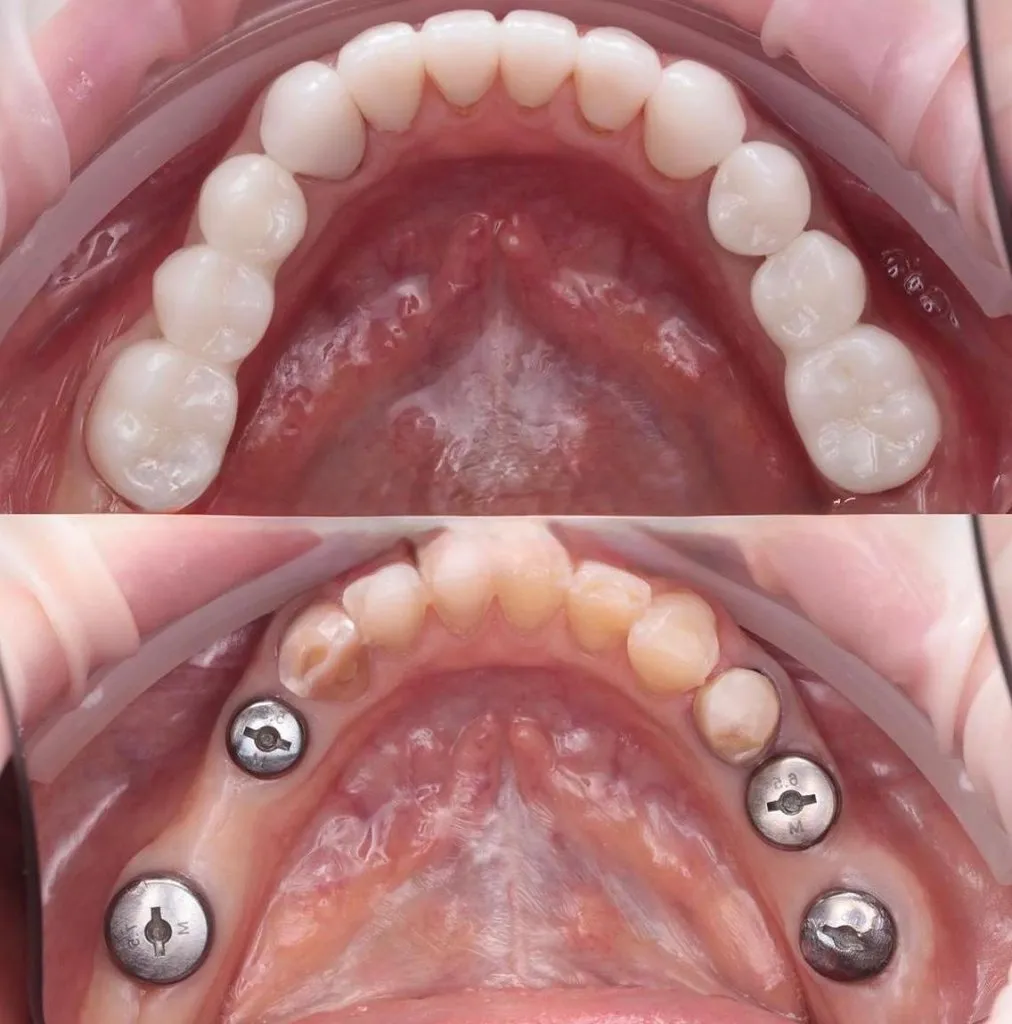
When every tooth in a jaw is missing, the comparison changes. A full denture relies on suction and, in the lower jaw, often never sits firmly. The fixed alternative is All-on-4: a full bridge on four implants, completed in two visits. Our All-on-4 guide explains who it suits.
What does each option cost?
We quote every case individually, because the amount depends on the number of teeth, the bone and the material: a three-unit bridge is quoted as three crowns, and an implant together with the crown on it. Examination, digital X-ray, local anaesthesia and check-ups are included. The page on how we quote explains how a quote is put together.
For a traveller the trips count too. A bridge is one journey. An implant is two, a few months apart, which is why many of our implant patients are people who holiday in Side anyway and place the two visits inside trips they were already planning. The how many days do I need page sets out the timings, and dental tourism explains how appointments fit around a holiday.
How we decide in Side
Send a photo of the gap and, if you have one, a panoramic X-ray on WhatsApp to +90 530 575 47 18. Dt. Mustafa Yunusoğlu reviews them personally and you receive a written treatment plan within 24 hours. If both an implant and a bridge are possible for your gap, the plan prices both, states what each would mean for the neighbouring teeth, and gives the schedule for each, so the decision is yours and is made on paper rather than in the chair.
The dental crowns page covers the materials used for bridges, our dental implants guide covers the surgery and healing in detail, and the contact page has every way to reach us.
Frequently Asked Questions
Is a dental implant better than a bridge?
Next to healthy teeth, usually yes: an implant leaves the neighbouring teeth untouched and keeps the jawbone in use, whereas a bridge needs both neighbours ground down for crowns. If those teeth already have large fillings or crowns, if surgery is not advisable, or if you cannot make two trips, a bridge is a sound choice. Over ten years the two last about equally long.
How long does a bridge last compared with an implant?
In a systematic review of long-term studies, 89.2% of conventional bridges and 89.4% of implant-supported crowns were still in service after ten years. The implants themselves survived in about 95% of cases at ten years. The practical difference is that a worn implant crown is replaced on the same implant, while a failing bridge can damage the teeth that carry it.
Can I get a bridge in one trip to Turkey?
Yes. A bridge needs no surgery and no healing period, so it is completed in one visit of 5‑7 days: preparation and a temporary bridge first, then the final bridge and a check-up before you fly. A single implant needs two visits, 3‑5 days and then 4‑7 days after 2‑4 months of healing.
What happens if I do not replace a missing tooth?
Over a few years the neighbouring teeth tip into the gap, the opposing tooth grows out of its socket, and the jawbone under the gap thins because it is no longer loaded. That makes later treatment harder. The exception is a missing last molar at the very back, which does not always need replacing.
Does a bridge damage the neighbouring teeth?
It requires them to be reduced on every side to take crowns, which removes most of the visible tooth. If they were already heavily filled, that may even protect them. If they were healthy, it is a real cost, and a crowned tooth carries a small long-term risk of needing root canal treatment.
Are dentures a good alternative to implants?
A removable partial denture is the lowest-cost option and needs little or no preparation of the teeth, and it is a useful temporary solution while an implant heals. As a permanent answer it moves when you chew, covers part of the gum, loads the teeth its clasps hold, and needs relining as the bone under it shrinks.
How many implants do I need if several teeth are missing?
Rarely one per tooth. Two implants can carry a fixed bridge of three or four teeth, and a whole jaw can be restored with a full bridge on four implants (All-on-4). Your written plan states the number of implants and why.
Sources
- Pjetursson et al. (2007), Clin Oral Implants Res: Survival and complication rates of tooth-supported and implant-supported fixed prostheses compared
- Jung et al. (2012), Clin Oral Implants Res: Survival and complications of single crowns on implants, systematic review
- Oral Health Foundation: Dental implants
- ADA MouthHealthy: Bridges
- NHS: Dentures (false teeth)
- Oral Health Foundation: Dentures