
Black Triangles Between Your Teeth: Why They Appear and How They Are Closed
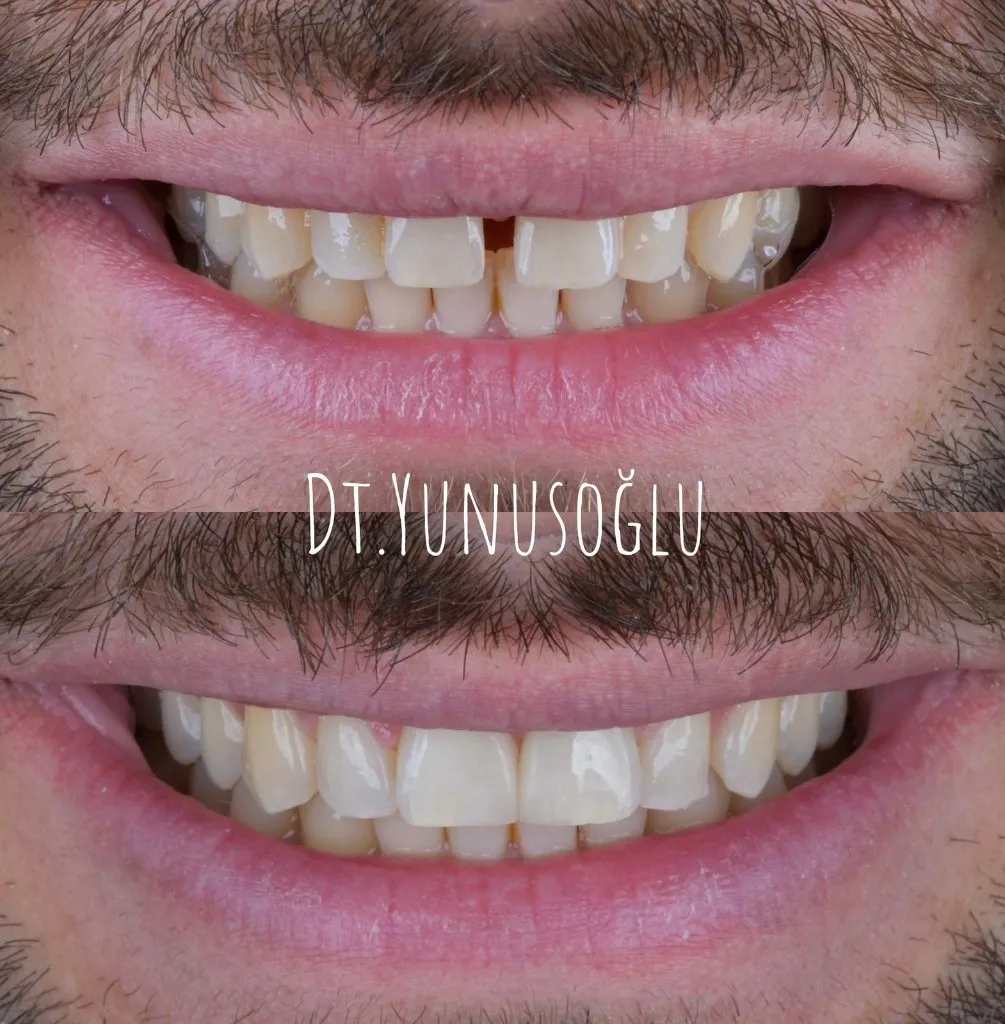
A black triangle is the dark gap that shows between two teeth near the gum when the little point of gum between them, the papilla, no longer fills the space. It is not decay, it is common, and in many mouths it can be closed in a single visit: bonding adds tooth-coloured material to the sides of the teeth so the gap disappears. Which route suits you depends on the cause, and the gums must be healthy first, so the first step is an examination, not a filling.
What is a black triangle, and why does it appear?
Below the point where two teeth touch, a small triangle of gum normally fills the space. When that gum shrinks, or when the teeth touch too high up, a dark triangle shows. It is not stain or dirt. It is simply the shadow of an open space, and food can collect in it.
| Cause | Usual first option | Note |
|---|---|---|
| Gum recession, for example after gum disease | Treat the gums first, then bonding or veneers | Gums must be healthy and settled before material goes near the gum line |
| Bone loss around the teeth | Bonding to close the gap; gum specialist if you hope to regain the papilla | A papilla often cannot refill when the bone is far below the contact point |
| Triangular tooth shape, wide at the edge and narrow at the gum | Bonding or veneers | The gap is built into the shape, so reshaping solves it |
| After braces or aligners | Bonding; sometimes small adjustments by the orthodontist | Common in adults; tell whoever did the braces |
| Roots that lean apart | Orthodontic movement, or bonding for a small gap | Movement takes months and rarely fits a holiday |
Research on adults after braces links black triangles to a bone-to-contact distance above 5.5 mm, short contacts placed high up, roots that diverge and triangular crown shapes. Causes often combine.
The measurement that matters most is the distance from the contact point to the top of the bone. In a 1992 study of 288 sites in 30 patients, the papilla was almost always present when that distance was within 5 mm. At 6 mm it was present 56% of the time, and at 7 mm or more in no more than 27% of sites. In plain words: the papilla needs bone under it. Where bone has been lost, the gum drops with it, and nobody can honestly promise that it will grow back.
How common are black triangles?
More common than most people expect, especially in adults who have had braces. One study of 337 adults after orthodontic treatment found open gaps near the gum in 38% of them. A study of 80 patients aged 15 to 31 found them in 43.7%, and in 66.7% of those over 20. A systematic review of ten studies with 1,246 patients reported a range from 18% to 78%, with low certainty of evidence, and named the distance from contact point to bone, tooth shape, crowding and age as the factors that came up most.
These figures come from orthodontic patients, because that is where black triangles have been measured most closely. They do show one thing clearly: if you have them, you are in large company, and the cause is usually something specific that can be named at an examination.
Why must the gums be healthy first?
Because everything that closes a black triangle is placed at the gum line. Bonding needs a dry, calm gum edge. An inflamed gum bleeds, swells and moves, so material placed against it ends up in the wrong place and shows a step or a dark edge once the swelling settles. After gum treatment the gum often shrinks, and a triangle can look larger than it did before. That is why the gums come first, and why it is better to know it before the work than after.
There is a second reason. If gum disease caused the bone loss, closing the gap hides the sign and leaves the disease untreated. Our guide on bleeding gums before veneers, crowns or implants explains what the examination looks for and what is done first.
How does bonding close a black triangle?
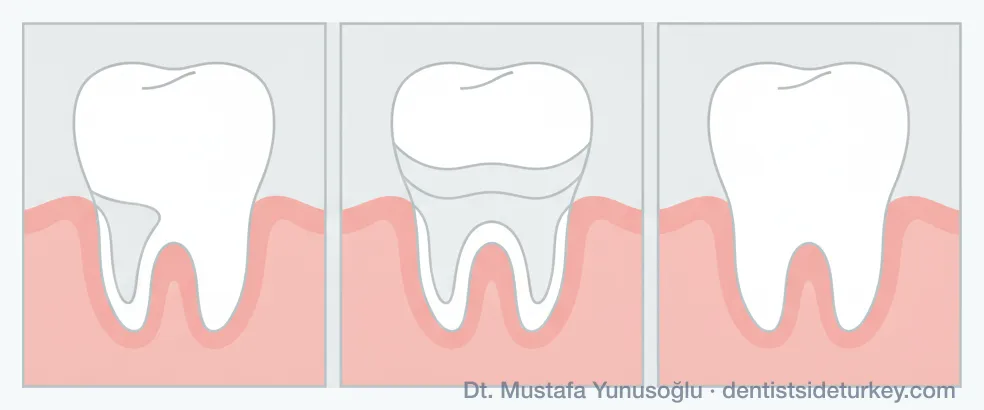
The dentist adds tooth-coloured composite to the sides of the two neighbouring teeth, so that the point where they touch moves down towards the gum. The material is shaped by hand in one session of 30‑90 minutes, usually without anaesthesia, and little or no enamel is removed. Composite bonding lasts about 5‑7 years and can be polished or topped up. The treatment is described on our aesthetic fillings page and in the composite fillings guide.
The limit is simple. The further the gum has dropped, the longer or squarer the teeth must look to close the space. A small triangle closes almost invisibly. A large one is a compromise, and the dentist should show you on photos what the teeth will look like before starting. The new contact also has to stay cleanable with floss or a small interdental brush, otherwise the problem only changes place.
When are veneers, braces or gum treatment the better route?
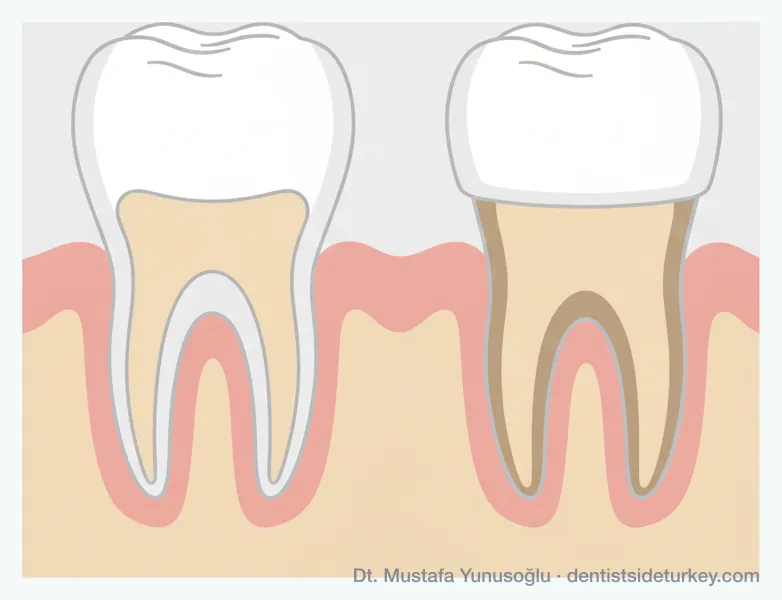
Veneers suit a smile where several teeth need work, or where shape and colour are changing as well. They take 5‑7 days with two appointments and carry a written 5-year guarantee. The differences are set out in veneers, crowns or bonding, and the treatment is on the dental veneers page. A related question, a gap between the front teeth, is covered in bonding or veneers for a gap.
Orthodontic treatment is the route when the cause is crowding or roots that lean apart. It moves the roots closer and takes months, so it is a job for your orthodontist at home. Gum treatment is a specialist field. A 2026 review describes the management of open embrasures as interdisciplinary, combining gum, orthodontic and restorative work, and it says clearly that more research on the individual methods is needed. Where the bone is far below the contact point, a full papilla should not be promised.
What will not work?
Whitening does nothing, because the triangle is a shadow, not a stain. Brushing harder wears the gum back and makes things worse. Forcing a large interdental brush into a tight space can injure the papilla. Gum-regrowth pastes and rinses do not rebuild lost bone. A correctly sized interdental brush is a good habit for gum health, but it will not refill the space, and waiting alone rarely changes it.
When is the clinic route not the right choice?
If your gums bleed easily, look swollen or the teeth feel loose, treat the gums first. That may mean a periodontist at home, and the dentist will tell you after the examination. If you still have braces or have just finished, wait: teeth settle for a while, and bonding done too early may need redoing. If what you want is the gum itself back, no filling material does that. And if there is pain, swelling or pus at the gum, that is a problem for the emergency dentist, not a cosmetic one.
Can you have it done on holiday in Side?
A small black triangle fits easily into a holiday, because bonding is a single session. The clinic is in Manavgat, 5‑25 minutes by car from Side centre, Kumköy, Çolaklı, Titreyengöl, Evrenseki, Kızılağaç and Gündoğdu, with chairs Monday to Saturday, 09:00 to 19:00, and closed on Sunday. Send photos on WhatsApp, with a close-up of the gap and one of your smile, and a written plan arrives within 24 hours. The guide to a treatment plan from photos shows what to send.
Finished work is in the smile gallery, and the contact page lists every way to reach us. Results depend on the individual case and the examination.
Frequently Asked Questions
What is a black triangle between teeth?
A dark, triangular gap near the gum between two teeth, which appears when the small point of gum between them (the papilla) no longer fills the space. It is not decay. It is a shadow, and food can collect in it.
Why do black triangles appear after braces?
Straightened teeth sometimes sit with their contact point too far above the bone, and bone at the crest can shrink during treatment. A study of 337 adults found open gaps in 38% after orthodontic treatment, and a separate study of 80 patients found 43.7%, more often in those over 20.
Can black triangles be closed in one visit?
Often yes. Bonding adds tooth-coloured composite to the sides of the neighbouring teeth in one session of 30‑90 minutes, usually without anaesthesia. A small triangle closes almost invisibly; a large one is a compromise, and the dentist shows you the likely result first.
How long does a bonded black triangle last?
Composite bonding lasts about 5‑7 years and can be polished or topped up. Good cleaning around the new contact with floss or a small interdental brush helps it last.
Will the gum grow back?
Not reliably. The papilla needs bone beneath it: a 1992 study found it almost always present when the bone lay within 5 mm of the contact point, and in no more than 27% of sites at 7 mm or more. Gum specialists have methods, but results are hardest where bone is lost.
Do I need healthy gums before the treatment?
Yes. Bonding needs a dry, calm gum edge, and an inflamed gum changes shape once treated. If your gums bleed or look swollen, they are treated first, which is also what makes the result last.
Can I get black triangles closed while on holiday in Side?
Often, if the gums are healthy. Bonding takes one session of 30‑90 minutes; veneers take 5‑7 days with 2 appointments. Send photos on WhatsApp +90 530 575 47 18, answered at any hour, and a written plan arrives within 24 hours.
Sources
- Tarnow et al. (1992), J Periodontol: The effect of the distance from the contact point to the crest of bone on the presence or absence of the interproximal dental papilla
- Kurth et al. (2001), Am J Orthod Dentofacial Orthop: Open gingival embrasures after orthodontic treatment in adults, prevalence and etiology
- Ko-Kimura et al. (2003), Aust Orthod J: Some factors associated with open gingival embrasures following orthodontic treatment
- Angioni et al. (2026), Int J Dent: Incidence of open gingival embrasure during orthodontic treatment and associated factors, a systematic review
- Ogawa et al. (2026), J Esthet Restor Dent: Interdisciplinary management of open interproximal embrasures
- NHS: Gum disease