
Bleeding Gums Before Veneers, Crowns or Implants: Why the Gums Come First

If your gums bleed when you brush, look swollen or have started to recede, they need attention before veneers, crowns or implants, not after. New work is fitted right at the gum line, and inflamed gums move as they heal, bleed during the impressions and leave dark edges or gaps a few months later. For implants, untreated gum disease is one of the clearest risks. Healthy gums first is not a delay; it is what makes the result last.
Why do the gums matter before cosmetic treatment?
Because every crown and veneer ends at the gum. The edge of the new work is placed just at or just under the gum line, and the dentist judges where that line is on the day of the impression. If the gum is swollen, the line is in the wrong place. When the swelling settles, the gum shrinks back and the edge of the crown appears, sometimes as a dark line, sometimes as a small step that catches food.
| What you notice | What it often means | What usually happens first |
|---|---|---|
| Bleeding when brushing or flossing | Inflamed gums, gingivitis | Professional cleaning and better home care for a few weeks |
| Swollen, red gum edges | Inflammation at the gum line | Same; impressions wait until it settles |
| Bad breath that does not go away | Bacteria in deeper gum pockets | Examination of the pockets and X-ray |
| Gums receding, teeth looking longer | Recession, sometimes after old gum disease | Plan the edges of new work around the new gum line |
| Loose or drifting teeth | Bone loss from periodontitis | Gum treatment and an honest look at which teeth can be kept |
How common is gum disease in adults?
Very common, and most people with it do not feel pain. A 2014 global review that combined studies covering 291,170 people estimated that severe periodontitis, the stage that destroys bone around the teeth, affects about 11.2% of adults, and that it becomes more common with age. Milder inflammation of the gums is far more widespread still. The European Federation of Periodontology and the NHS both describe bleeding gums as the first sign that should not be ignored.
The people who look for veneers, crowns and implants are often exactly the age group where gum disease is most common. That is why a good plan always looks at the gums, even when the question you asked was about colour or shape.
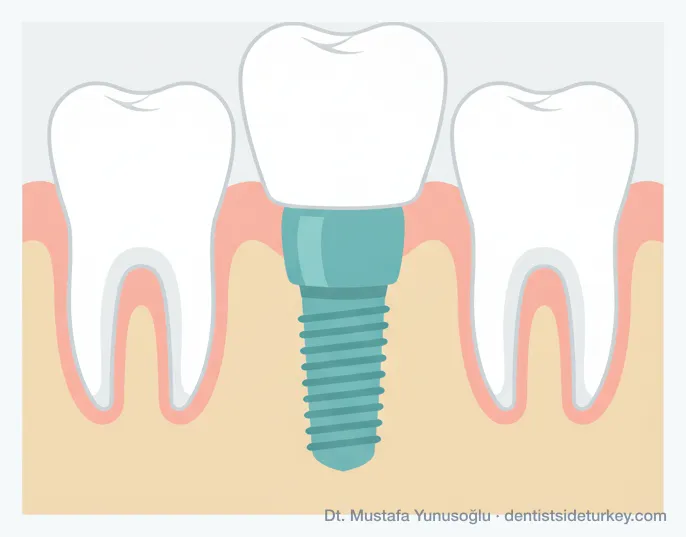
What does gum disease mean for implants?
An implant is held by bone, and the bacteria that destroy the bone around teeth can attack the bone around an implant in the same way. A meta-analysis found that people with a history of periodontitis had a higher risk of losing an implant, with a risk ratio of 1.69, and a higher risk of peri-implantitis, the gum disease of implants. This does not mean implants are impossible. It means the gum disease must be under control first, and that regular cleaning afterwards matters more than for anyone else.
Smoking and diabetes add to the same risk. Our post on implants with smoking, diabetes or gum disease looks at each one. How the implant itself works is on the dental implants page.
How is this planned before a trip to Side?
Ideally before you book flights. When you send 2‑3 photos of your teeth, and a recent panoramic X-ray if you have one, the photos show red or swollen gum edges and recession, and the X-ray shows bone levels around the roots. The written plan you receive within 24 hours says whether the gums need treatment before anything else, and roughly how long they need.
Gums need weeks, not days, to settle after cleaning. That is why the simplest route is often a professional cleaning with your own dentist or hygienist a few weeks before the trip, followed by careful brushing and cleaning between the teeth at home. By the time you arrive the gums are calmer, and the plan is confirmed by examination and digital X-ray on the first day. Our guide to planning from photos explains what photos can and cannot show.
If you are unsure whether your gums are a problem, send a photo on WhatsApp and ask. It costs you a message and may save you a trip planned in the wrong order.

When should cosmetic work wait?
When teeth are loose, when the gums bleed heavily or when the X-ray shows active bone loss. In that situation veneers or crowns on teeth whose support is failing are money spent in the wrong place, and the honest advice is to treat the gums first, at home, over several months, with a dentist who can see you regularly. Only then does it make sense to decide which teeth can carry new work and which should be replaced.
The same applies if the gums have receded a lot and you want very white crowns on teeth with exposed roots. The plan has to account for where the gum is now, not where it used to be. Replacing old work in that situation is covered in replacing old crowns and bridges.
What helps the result last once the work is done?
The same things that kept the gums healthy before it: brushing twice a day along the gum line, cleaning between the teeth every day with floss or small brushes, not smoking, and regular cleaning with a dentist or hygienist at home. Crowns and veneers carry a written guarantee of 5 years and implants 10 years; healthy gums are part of what keeps that work sound. Follow-up after you fly home is described in aftercare and the guarantee.
Crowns and veneers take 5‑7 days with two appointments, implants two visits a few months apart, as the page on how many days you need sets out. Details of the cosmetic treatments are on the porcelain veneers page, and the contact page lists every way to reach us. Results depend on each case and the examination.
Frequently Asked Questions
Can I get veneers if my gums bleed?
Not until the bleeding is under control. Veneers and crowns are fitted at the gum line, and inflamed gums move as they heal, which can leave dark edges or small gaps later. Usually a professional cleaning and better home care for a few weeks come first. Send photos and the written plan will say whether the gums need treatment first.
Can I have implants if I have had gum disease?
Often yes, once the gum disease is under control. A meta-analysis found a higher risk of implant loss and of peri-implantitis in people with a history of periodontitis, so the gums are treated first and regular cleaning afterwards is essential. The examination and X-ray decide whether and when implants are suitable.
How long before my trip should I treat my gums?
Gums need weeks to settle after cleaning, so a professional cleaning a few weeks before the trip, followed by careful daily brushing and cleaning between the teeth, is a sensible plan. If the gums need deeper treatment, it may take months, and cosmetic work should wait.
Why do my teeth look longer than before?
Usually because the gums have receded, sometimes after past gum disease or hard brushing. Exposed roots can be sensitive and darker than the enamel. New crowns or veneers have to be planned around where the gum is now, which the dentist checks on photos and at the examination.
Can photos show gum disease?
Photos show red or swollen gum edges, recession and tartar, but not the depth of the gum pockets or the bone level. A panoramic X-ray shows bone loss around the roots. The plan from photos is confirmed by examination and digital X-ray on the first day.
Will gum disease affect my guarantee?
Crowns and veneers carry a written guarantee of 5 years and implants 10 years. Healthy gums and regular cleaning are part of keeping that work sound. Ask about the guarantee terms when you receive your plan.
What is the first step if my gums bleed?
Send 2‑3 photos of your teeth on WhatsApp to +90 530 575 47 18, with a recent panoramic X-ray if you have one, and mention the bleeding. Dt. Mustafa Yunusoğlu reviews them personally and the written plan within 24 hours says whether the gums should be treated first.
Sources
- Kassebaum et al. (2014), J Dent Res: Global burden of severe periodontitis 1990-2010, systematic review and meta-regression
- Sgolastra et al. (2015), Clin Oral Implants Res: Periodontitis, implant loss and peri-implantitis, meta-analysis
- European Federation of Periodontology: information for patients
- NHS: Gum disease
- Oral Health Foundation: Gum disease