
Dental Implants, Airport Security and MRI: What You Need to Know
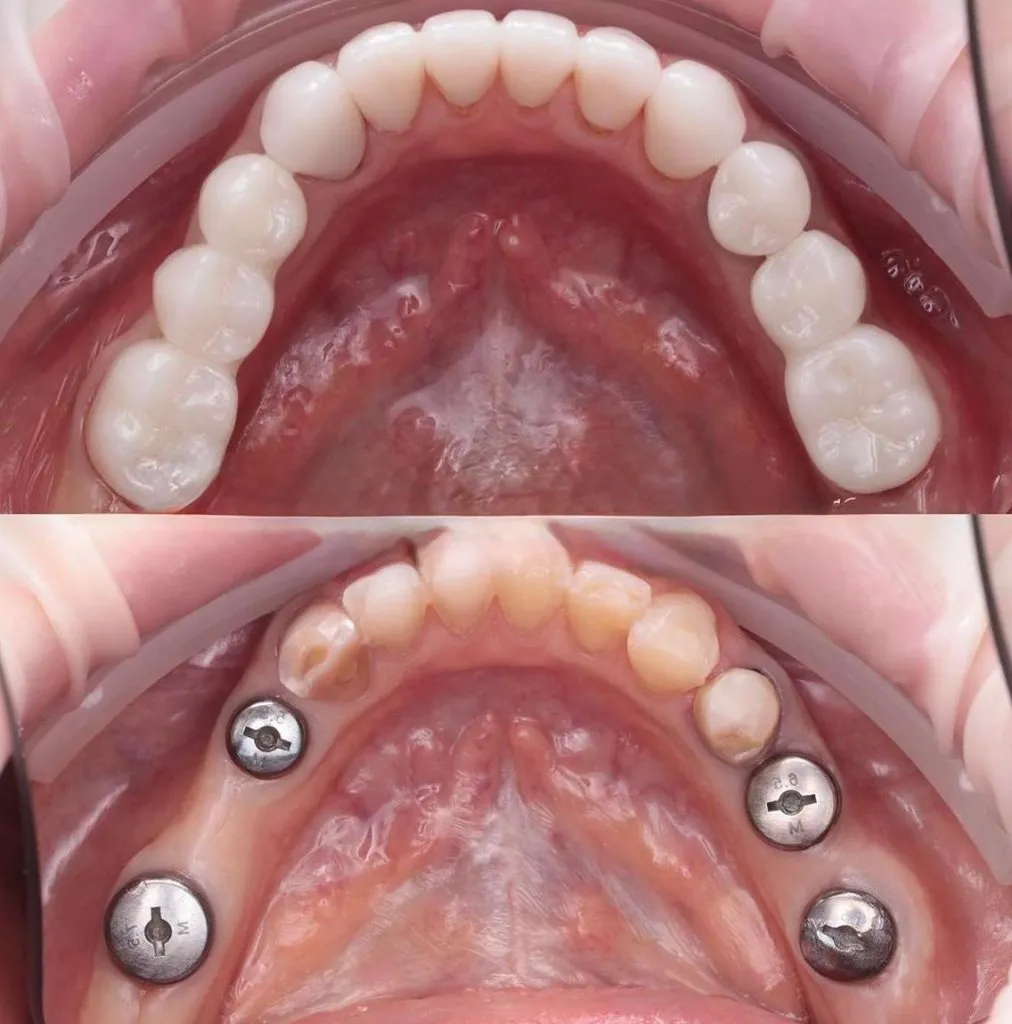
A dental implant is a small piece of titanium, far smaller than a hip replacement, and even hip replacements are picked up by airport metal detectors only some of the time, from 23% to 86% of patients in one survey depending on size and flight type. We found no study that counted alarms for dental implants, so nobody can promise silence, but a hand search settles any alarm. For an MRI, implants and crowns do not rule out a scan; they blur the picture close to the mouth, more with titanium than with zirconia. Tell the officer or the radiographer what you have, and bring your treatment record.
What is in your mouth, and does it matter at the airport and in a scanner?
| What is in your mouth | Airport metal detector | MRI | Note |
|---|---|---|---|
| Titanium implant with a crown | Very little metal; an alarm is possible, but nobody has measured it for dental implants | Scan is possible; distortion near the mouth, larger than with zirconia | Implant brand is on your treatment record |
| Zirconia crown | Ceramic, no metal in the crown | Small distortion; the fewest artefacts when combined with a zirconia implant | The crown itself contains no metal |
| Metal-ceramic crown (porcelain over a metal core) | A little metal | Depends on the alloy; a non-precious cobalt-chromium alloy gave the largest distortion | Ask which alloy was used |
| Metal (amalgam) filling | A little metal | The NHS form asks you to name dental fillings | Classed as workable in a laboratory study of dental MRI |
| Braces or fixed retainer (stainless steel) | More metal in the mouth | Stainless steel appliances were classed as unsuitable for dental MRI | Mention it before any head or neck scan |
Will a dental implant set off the airport metal detector?
A walk-through detector reacts to the amount and type of metal that passes through it. The clearest numbers we found are for hip replacements, a much larger implant. A Japanese survey of 1,684 hip replacement patients, of whom 671 had flown, found that detectors picked up the implant in 23% of those with one hip on domestic flights, 56% with one hip on international flights, 75% with two hips on domestic flights and 86% with two hips on international flights. The size of the hip socket component was the strongest predictor.
A dental implant is a fraction of that size, so an alarm is less likely, but we found no study that counted them, and detector settings differ between airports. A zirconia crown contains no metal. Metal-ceramic crowns, metal fillings, braces, fixed retainers, removable dentures with metal clasps and lip or tongue piercings all add a little metal. If you alarm, the officer will use another screening method, such as a hand search.
What should you tell the security officer?
The TSA, the US security agency, asks travellers to inform the officer if they have any metal implants. If you choose not to use the body scanner or you set off the walk-through detector, the officer will do a pat-down. Other countries, including Turkey, follow their own procedures, so ask the officer and stay calm; a dental implant is an ordinary thing to have.
Say it once, early and briefly: "I have dental implants and crowns." You do not need to show your mouth. A pacemaker or similar device is different, and it is covered in the section on when this is not a dental question.

Does a dental implant matter for an MRI?
An MRI is the scan where you are asked about metal. The NHS form asks whether you have any metal parts in your body and names dental fillings and bridges among the examples, so tell the radiographer about your implants and crowns as well. The research on dental materials is mostly about image quality, not injury: metal distorts the magnetic field around it and leaves a dark or warped patch in the picture.
That patch stays close to the metal. A 2025 study from Aarhus compared titanium and zirconia implants and found that titanium distorted the field more, that the distortion grew with field strength (0.55 T, 1.5 T, 3.0 T), and that the artefacts showed mainly as signal voids in the crown area. A scan of a knee or the abdomen is far from your mouth. A scan of the jaw, sinuses, neck or brain is where the metal can matter, and the radiologist decides whether the picture is still readable.
Titanium or zirconia, metal-ceramic or zirconia crown: what changes for scans?
A laboratory study at 3 T tested one zirconia and four titanium implants with different single crowns. The fewest artefacts came from a zirconia implant with a monolithic zirconia crown. A titanium implant under a crown with a non-precious alloy framework (cobalt, chromium, tungsten) was the worst. Titanium implants under precious-alloy, porcelain-fused-to-zirconia or monolithic zirconia crowns gave smaller and similar artefacts. So the crown matters nearly as much as the implant.
Another laboratory study of dental MRI classed zirconia as fully compatible, titanium alloy, gold and amalgam as workable with some distortion, and stainless steel appliances and cobalt-chromium as unsuitable for imaging the teeth themselves. These are small laboratory studies, not a reason to choose a material. At our clinic implants are titanium systems from Nobel Biocare and Straumann, and crowns are CAD/CAM zirconia, which contains no metal. The choice for each mouth is decided on examination; our pages on dental implants, dental crowns and E-max versus zirconia explain the options.
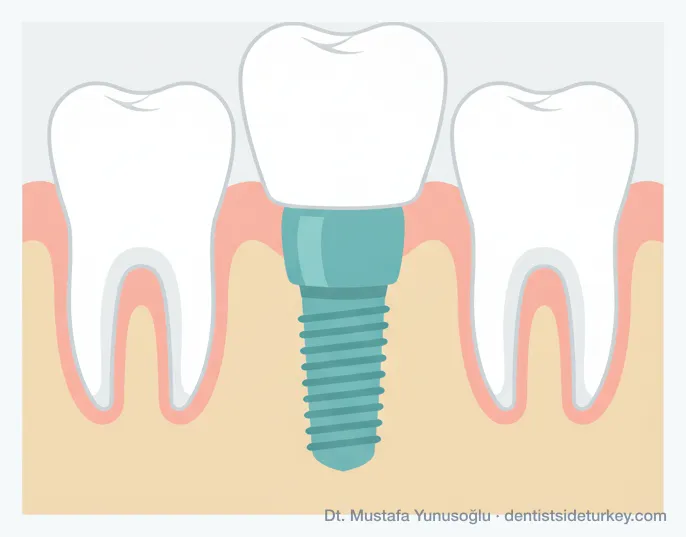
What should you tell the radiographer, and is a treatment record useful?
Tell them how many implants you have and where, what the crowns are made of if you know, and whether you wear braces, a fixed retainer or a denture with magnetic attachments. Mention piercings as well. If a doctor has ordered a scan, do not cancel it because of dental work; give the information and let the imaging team decide.
A written record makes that easy. At Dentist Side Turkey you get a written treatment plan, a written guarantee (10 years on implants, 5 years on crowns and veneers) and, after treatment, the full treatment record with implant brand, materials and X-rays, so any dentist or hospital can read it. We do not issue a special implant passport. The record plus your own words is what helps. More on what follows after you fly is in after you fly home: guarantee and follow-up.
When is this not a question for the dental clinic?
If you also have a pacemaker, defibrillator or another internal device, ask your doctor first. The TSA says people with such devices should not be screened by the walk-through detector and should consult their physician before flying. Whether an MRI is safe for a device is for your hospital to decide.
The same goes for any scan you are booked in for: the imaging department, not a dentist, decides whether it goes ahead. We can send the record; we do not make that call. If you are still choosing a treatment, the material question is a footnote to the real decision, which is made on bone, gums and bite at examination. Our guide to implant, bridge or denture covers that.
Can you ask us before you fly?
Yes. The clinic works Monday to Saturday, 09:00 to 19:00, and WhatsApp +90 530 575 47 18 is answered at any hour. Send us a message and we will tell you what you will receive. Practical tips for the trip are in our dental trip checklist and in flying after dental treatment. The implant guide and the contact page have the rest. Results depend on the individual case and the examination.
Frequently Asked Questions
Do dental implants set off airport metal detectors?
Possibly, but we found no study that counted alarms for dental implants. Even large hip replacements were picked up only some of the time in a Japanese survey, from 23% to 86% of patients depending on size and flight type. A dental implant is far smaller. If you alarm, a hand search settles it, and it helps to tell the officer first.
Does a zirconia crown set off a metal detector?
A zirconia crown is ceramic and contains no metal. Other things in the mouth, such as metal fillings, braces, fixed retainers or a titanium implant, may add a little metal.
Is it safe to have an MRI with dental implants?
Tell the radiographer about your implants, crowns and fillings; the NHS MRI form asks about metal in the body and names dental fillings and bridges. The research we found is about image quality: metal distorts the picture close to it. The imaging team decides whether the scan goes ahead.
Do titanium or zirconia implants cause fewer MRI artefacts?
In a 2025 study, titanium distorted the magnetic field more than zirconia, and the distortion grew with field strength. A 3 T laboratory study found the fewest artefacts with a zirconia implant and a monolithic zirconia crown. These are laboratory findings on small samples.
Do metal fillings or metal-ceramic crowns matter for MRI?
They add some metal, so tell the radiographer. A laboratory study of dental MRI classed amalgam and gold alloy as workable with some distortion, while a non-precious cobalt-chromium crown framework gave the largest distortion with a titanium implant.
What should I tell the security officer or the radiographer?
Say that you have dental implants and crowns, how many, and whether you wear braces, a fixed retainer or a denture with magnets. TSA asks travellers to tell the officer about any metal implant before screening.
Do I need an implant card or passport?
No special card is needed. At Dentist Side Turkey you get a written plan, a written guarantee (10 years on implants, 5 on crowns) and the full treatment record with implant brand, materials and X-rays. We do not issue an implant passport.
Sources
- Johannsen et al. (2025), Dentomaxillofac Radiol: Interference of titanium and zirconia implants on dental-dedicated MR image quality
- Hilgenfeld et al. (2016), Eur J Oral Implantol: Artefacts of implant-supported single crowns, impact of material composition on dental MRI
- Tymofiyeva et al. (2013), Dentomaxillofac Radiol: Influence of dental materials on dental MRI
- Kimura et al. (2020), J Orthop Sci: Detection of total hip prostheses at airport security checkpoints
- TSA: Disabilities and medical conditions, implants and internal medical devices
- NHS: MRI scan, how it is done and preparing for it