
Dental Implants: Complete Guide to Treatment, Cost Factors & Recovery
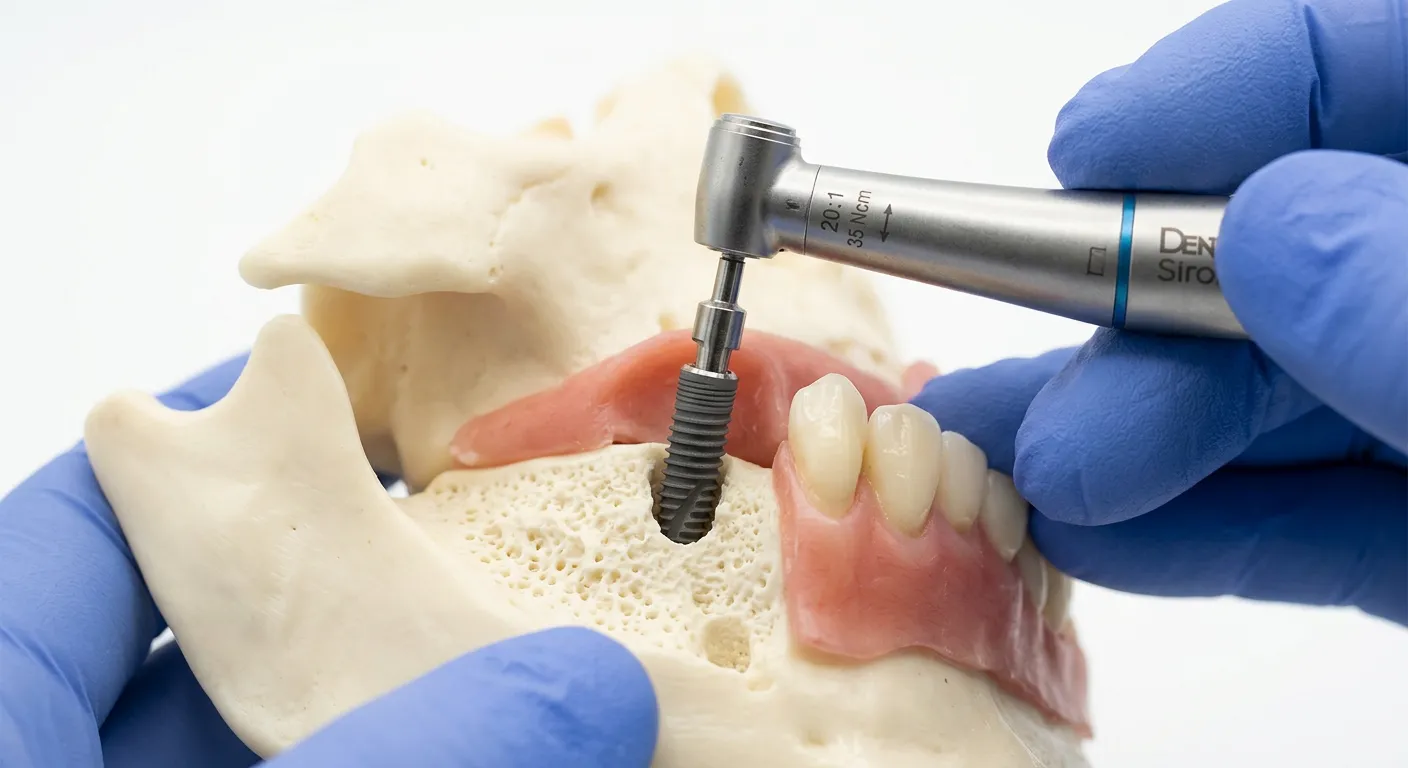
Dental implants are titanium posts placed into the jawbone to replace missing teeth permanently, topped with a porcelain or zirconia crown. In Side, Antalya, a single dental implant with its crown is completed over two short visits and backed by a 10-year written guarantee.
What Are Dental Implants?
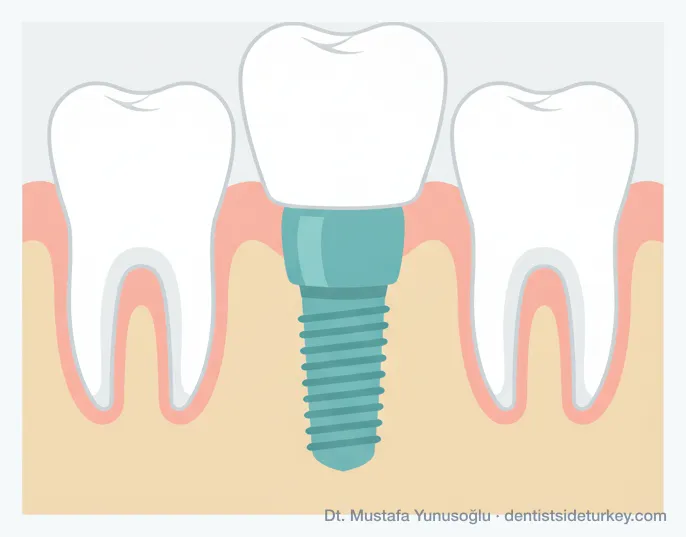
Dental implants are titanium screws placed into the jawbone to replace missing teeth, topped with porcelain or zirconia crowns for a permanent, natural-looking result. Considered the gold standard in modern dentistry, implant therapy can address everything from a single missing tooth to complete edentulism. Unlike a traditional bridge, an implant does not rely on neighbouring teeth for support: the titanium post takes over the role of the natural tooth root, preserving the jawbone and keeping adjacent teeth untouched. That is why dentists increasingly recommend implants as the first-choice solution whenever a tooth cannot be saved.
A Brief History
The concept of osseointegration was first discovered in 1952 by Swedish physician and research anatomist Prof. Per-Ingvar Brånemark, who observed that living bone fuses tightly with titanium. This breakthrough laid the foundation for modern implantology and has since improved the quality of life for millions of patients worldwide. Today's implant systems from premium manufacturers such as Nobel Biocare and Straumann build on more than five decades of clinical research, with documented long-term success rates above 98%.
Who Is a Candidate for Implants?
Implant treatment is indicated for:
- Patients with single tooth loss who want a fixed replacement
- Individuals experiencing multiple tooth loss in one or both jaws
- Cases of complete edentulism, where implant-supported bridges or dentures restore full function
- Patients who don't want healthy adjacent teeth trimmed down for a bridge
- Those dissatisfied with the fit, comfort or stability of removable dentures
In general, any adult with completed jaw growth (usually from age 18) and reasonably good oral health can be considered. Age itself is not a barrier - implants are routinely placed in patients in their seventies and eighties. What matters most is the quantity and quality of bone at the implant site and the patient's overall health.
Contraindications
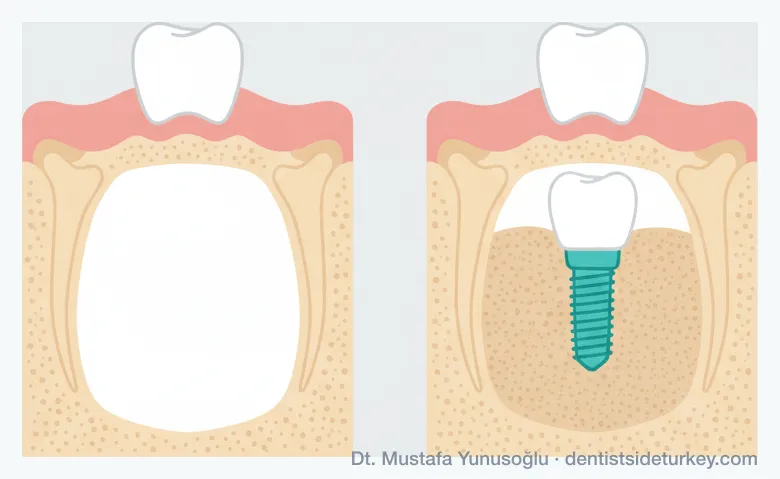
Uncontrolled diabetes, severe osteoporosis, active periodontal disease, heavy smoking and certain immunodeficiency conditions may pose relative contraindications. However, most of these can be managed before proceeding with implant placement: gum disease is treated first, diabetes is brought under control, and smokers are asked to stop or significantly reduce smoking around the surgery. If bone volume is insufficient, techniques such as bone grafting or sinus lifting can rebuild the site - this is assessed during the 3D scan at your first examination.
How Does the Treatment Process Work?
1. Examination & Planning
Bone structure is evaluated using digital panoramic X-rays and 3D volumetric tomography (CBCT). The scan shows bone height, width and density as well as the position of nerves and sinuses, allowing the implant size and angle to be planned to the millimetre. A digital smile design completes the treatment plan, and you receive a fixed written quotation before anything begins - you can compare it with our full price list in advance.
2. Surgical Phase
Under local anaesthesia, the titanium implant screw is placed into the bone through a small opening in the gum. The procedure typically takes 30‑60 minutes per implant and is virtually painless under local anaesthesia - most patients describe it as easier than a routine filling. For anxious patients, sedation options can be discussed at the consultation.
3. Osseointegration (Healing)
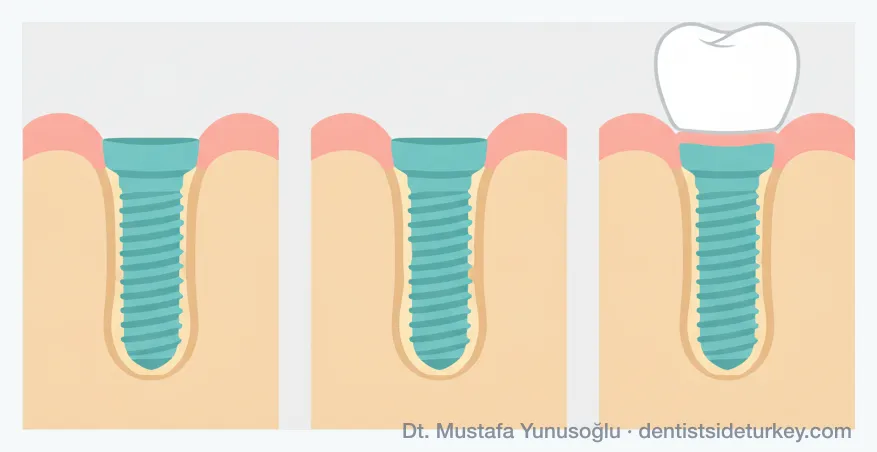
The implant fuses with the jawbone over 2‑4 months (up to 6 in the upper jaw, where bone is softer). During this biological healing phase the bone cells grow directly onto the titanium surface, anchoring the implant as firmly as a natural root. A temporary prosthesis can be worn during this period, so you are never left without teeth.
4. Abutment & Impressions
Once healing is complete, a small connector piece called an abutment is attached to the implant and precise digital impressions are taken. These are sent to the dental laboratory, where your permanent crown is crafted to match the shade and shape of your natural teeth (see our dental crowns guide for the material options).
5. Crown Placement
The permanent porcelain or zirconia crown is fitted, checked for bite and aesthetics, and secured onto the implant. From this moment you can eat, speak and smile exactly as you would with a natural tooth.
Healing & Aftercare Timeline
Knowing what to expect makes recovery far less stressful. Here is the typical course after implant surgery:
- First 24‑48 hours: Mild swelling and slight discomfort are normal and controlled with standard painkillers. Apply cold compresses, avoid hot drinks, and do not rinse vigorously so the blood clot stays undisturbed.
- Days 3‑7: Swelling subsides. Stick to soft, lukewarm foods (soups, yoghurt, eggs, pasta) and chew on the opposite side. Gentle salt-water rinses keep the area clean. Most patients return to work within 1‑2 days.
- Weeks 2‑8: The gum has healed over and daily life feels completely normal. Brush carefully around the site and avoid smoking, which slows bone healing significantly.
- Months 2‑4 (up to 6 in the upper jaw): Osseointegration completes. The implant is tested for stability and, once confirmed, the permanent crown is fitted.
- Long term: Brush twice daily, use interdental brushes around the implant crown, and attend check-ups every 6 months. With this routine, an implant can last a lifetime.
Implant Options: From a Single Tooth to a Full Arch
Single Implant
One titanium post and one crown replace a single missing tooth. This is the most common scenario and the simplest to plan: neighbouring teeth remain completely untouched, and the bone under the gap is preserved instead of shrinking away as it would under a bridge or denture.
Implant-Supported Bridge
When three or four adjacent teeth are missing, you rarely need an implant for every tooth. Two well-positioned implants can carry a fixed bridge of three or four crowns, which reduces both surgery time and cost while still delivering a fully fixed result.
All-on-4 and All-on-6
For patients with complete or near-complete tooth loss, a full fixed arch can be anchored on just four or six implants - we cover this in detail in our All-on-4 implants guide. The angled placement of the posterior implants makes use of the strongest available bone, which often avoids the need for grafting entirely. Compared with a removable denture, a fixed full-arch restoration feels dramatically more stable - you bite into an apple, not around it.
Implant vs Bridge vs Removable Denture
Patients often ask how implants compare with the alternatives. In brief:
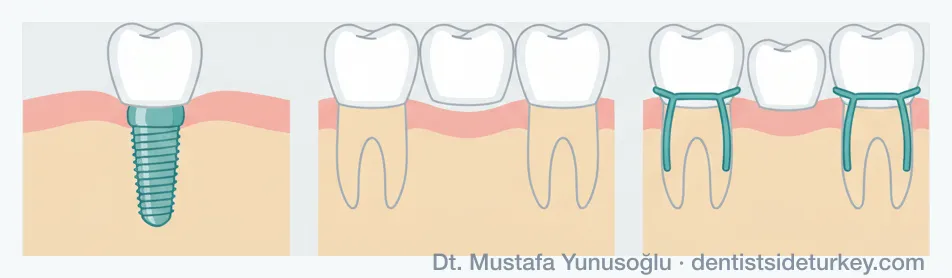
- Implant: Preserves bone, spares neighbouring teeth, feels and functions like a natural tooth, and typically lasts the longest. Higher initial cost, but usually the cheapest option over a lifetime.
- Conventional bridge: Faster to complete and requires no surgery, but the two healthy anchor teeth must be ground down, and the bone under the missing tooth continues to shrink. Average lifespan 10‑15 years.
- Removable denture: The lowest initial cost, but the least comfortable and least stable option. Bone loss continues under the denture, which is why dentures need relining and replacement over time.
Success Rates and Possible Risks
Dental implantology is one of the most predictable disciplines in medicine, with long-term success rates above 98% in healthy non-smokers. The main risks are infection around the implant (peri-implantitis), failure of osseointegration in the first months, and mechanical complications such as a loosened screw - all rare and all manageable when detected early. This is exactly why the planning CBCT scan, sterile surgical protocol and 6-monthly check-ups matter more than any single brand or price tag. Choosing an experienced surgeon and premium implant systems keeps every one of these risks at the low end of the published range.
Why Get Dental Implants in Side?
At Dentist Side Turkey we use the same implant brands you would receive in London or Berlin, Nobel Biocare and Straumann. Implant surgery is carried out by a dental surgeon specialising in implantology, in the clinic founded by Dt. Mustafa Yunusoğlu, which has treated international patients since 2015 and holds a 5.0-star Google rating across 63 reviews. Every implant comes with a 10-year written guarantee, and crowns and veneers carry a 5-year guarantee.
We do not publish a price list: the amount in your plan depends on how many implants you need, your bone volume and whether a graft or sinus lift is required, the implant brand and the crown on top. Send an X-ray or 2‑3 photos on WhatsApp and within 24 hours you receive a written plan with the full amount; the amount you approve after the examination is the amount you pay. Our page on how we quote explains the process, and brands, guarantee and treatment steps are on the dental implants in Side, Antalya page.
How Many Days Do You Need in Turkey?
Standard implant treatment is organised over two visits:
- First visit (3‑5 days): Examination, CBCT scan, implant surgery and post-operative check. If a bone graft or extractions are needed, plan for the upper end of this range.
- Second visit (4‑7 days, after 2‑4 months of healing): Abutment placement, impressions, laboratory fabrication of the crown, try-in and final fitting.
Both visits fit comfortably into a normal holiday, and Side's beaches, ancient ruins and resort hotels make the healing days genuinely enjoyable. Our team helps coordinate appointment dates around your flights - see the dental tourism page for how we combine treatment with a holiday, including airport transfer and accommodation guidance.
The day count for every treatment, side by side, is on our how many days do you need in Side for dental treatment page.
Two related guides: implant, bridge or denture: how to replace a missing tooth compares the alternatives honestly, and implants if you smoke, have diabetes or gum disease covers who is a candidate.
Post-Implant Care
- Brush twice daily and use interdental brushes around the implant
- Attend regular check-ups every 6 months
- Avoid hard foods during the first week after surgery
- Quit or reduce smoking - it is the single biggest controllable risk factor for implant failure
With proper care and regular check-ups, a well-placed implant can last a lifetime. The crown on top may need renewal after 10‑15 years - and ours are guaranteed for 5 years.
This article was written by Dt. Mustafa Yunusoğlu. For detailed information about dental implants and a consultation, contact us or reach us via WhatsApp at +90 530 575 47 18.
Frequently Asked Questions
Is the implant procedure painful?
The surgery is virtually painless under local anaesthesia. Mild swelling and discomfort for 1‑2 days afterwards are normal and easily managed with standard painkillers.
How long do dental implants last?
With good oral hygiene and 6-monthly check-ups, implants can last a lifetime. The crown on top may need replacement after 10‑15 years. We provide a 10-year implant guarantee and a 5-year crown guarantee.
How many days do I need to stay in Turkey?
Two visits: 3‑5 days for the implant surgery, then 4‑7 days after 2‑4 months of healing (up to 6 in the upper jaw) for the permanent crown. Both trips fit easily into a normal holiday in Side.
How much does a dental implant cost in Turkey?
We do not publish one figure, because the number of implants, your bone volume and any graft change it. We use premium Nobel Biocare and Straumann implants with a 10-year guarantee, and your exact price comes in writing within 24 hours.
Can I get a tooth on the implant the same day?
In suitable cases with good bone quality, a temporary crown can be fitted the same day (immediate loading), especially for front teeth. The permanent crown follows after the healing period of 2‑4 months (up to 6 in the upper jaw).
What if I don't have enough jawbone?
Bone grafting or a sinus lift can rebuild insufficient bone before or during implant placement. Your 3D CBCT scan at the first examination shows exactly what is needed, and the plan is confirmed before treatment begins.