
Veneers for Crooked Teeth or Braces? What Each Can Fix and How Much Enamel Veneers Take
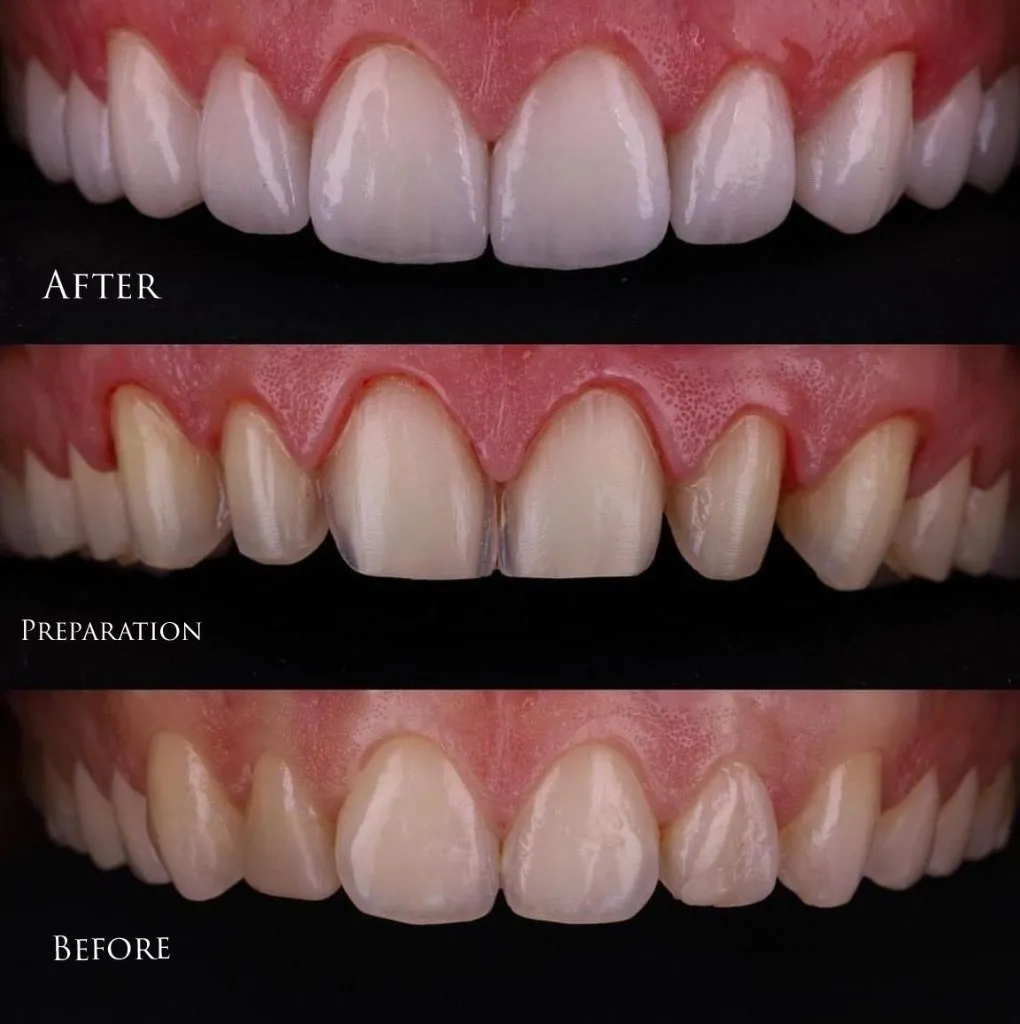
Mildly crooked or overlapping front teeth can be made to look straight with veneers or bonding in 5‑7 days, which is why veneers are sometimes called instant orthodontics. They work by reshaping the teeth, not by moving them, so the more a tooth is out of line, the more enamel has to be removed, and veneers cannot correct the bite. Braces and aligners move the teeth but take far longer: the NHS says a fixed brace usually stays on for 1‑2 years. We do not offer orthodontics at Dentist Side Turkey, so we tell you from photos and an examination whether your teeth suit veneers or whether an orthodontist should see you first.
Veneers or braces: which one suits your teeth?
The question is not which treatment is better in general. It is what is wrong with your teeth. A tooth that is slightly twisted is a different problem from a jaw that does not close properly. The table is a first guide; photos and an examination decide.
| Your situation | Veneers or bonding reasonable? | Why |
|---|---|---|
| One or two front teeth mildly rotated | Often yes | A little reshaping can hide the twist; bonding may need no drilling at all |
| Slight crowding, small overlaps | Sometimes | Possible if the teeth can be shaped within the enamel; the examination shows how much |
| Teeth that stick forward or sit behind the line | Limited | A veneer cannot move a tooth, so a protruding tooth must be cut back and a recessed one built out |
| Severe crowding | Usually no | Too much enamel would have to go, and the result can look bulky; an orthodontist first |
| Bite problem: overbite, underbite, crossbite | No, not for the bite | Veneers do not change how the jaws meet; braces or aligners do |
| Gaps between front teeth | Often yes | Bonding or veneers close small gaps quickly; see gap between front teeth |
How much enamel has to go when the teeth are out of line?
More than on a tooth that is already in the right place. A veneer sits on the front of the tooth and follows the line of the arch. If the tooth turns inward or outward, the dentist has to cut back the part that sticks out so the veneer does not look bulky, and the cut gets deeper the further the tooth is from the line. Our porcelain veneers page describes a minimal preparation of 0.3‑0.5 mm. That is the aim, and it is easiest on straight teeth. On a crooked tooth the examination shows whether it can be kept that thin.
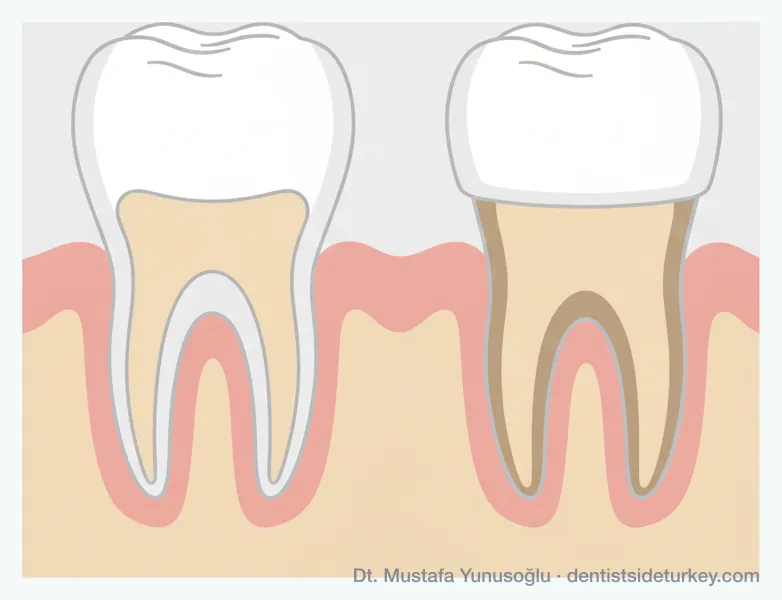
For scale, a laboratory study on model teeth found that veneer preparations removed roughly 3% to 30% of the crown's tooth structure by weight, depending on the design, while crown preparations removed roughly 63% to 72%. Even the lower end of that range is permanent: the ADA points out that the treatment is not reversible because enamel is removed.
Why does it matter if the preparation reaches dentin?
Enamel is the layer that veneers bond to reliably. A 2013 retrospective study followed 580 porcelain veneers in 66 patients for up to 12 years. Survival was 99% when the preparation stayed in enamel and 94% when only the edges were in enamel. Veneers bonded to dentin were about 10 times more likely to fail than those bonded to enamel. A 2012 review of 24 papers reached the same conclusion: there is reasonable evidence that preparing into dentin hurts survival, and the ideal preparation stays within enamel.
One detail in that study is worth knowing: crowding itself did not significantly change the failure rate. What mattered was how deep the preparation went. So a crooked tooth is not a bad candidate by itself. It becomes one when straightening its look would mean cutting through the enamel. That is the question we ask at the examination, and sometimes aesthetic fillings and bonding are the answer, because composite is added to the tooth and needs no reduction. Bonding takes one session of 30‑90 minutes and lasts about 5‑7 years.
What can veneers not fix?
The bite and the position of the jaws. If the upper and lower teeth do not meet properly, the NHS lists that, along with teeth growing too close together or large gaps, among the reasons to see an orthodontist. Veneers covering a deep overbite take heavy loads and can chip, and the ADA says clenching or grinding or a deep overbite may make veneers a poor choice. If you grind at night, a custom night guard is part of the plan; see grinding and veneers.
Veneers also do not treat gum disease or decay, which must be dealt with first, as gums before veneers explains. And veneers do not move roots, so a tooth that is in the wrong place under the gum stays there.
When is aligning first, then veneers, the better plan?
When the crowding is moderate to severe, when the bite is off, or when you want to keep every bit of enamel. Teeth that are moved into line first usually need only a thin preparation or none, and then veneers or bonding only have to deal with colour, shape and size. The orthodontist can also tell you which appliance suits the problem: a 2015 systematic review of 11 studies found that clear aligners level and align the arches but are not reliably effective at rotating rounded teeth.
Plan for time. The NHS describes appointments every 6 to 8 weeks and a retainer after the brace comes off, so this route is a project for home, not for a holiday week. The finishing touches fit a holiday well: bonding in one session, or veneers in 5‑7 days over 2 appointments. A tooth moved into line and then veneered is also a case where the number of veneers can be small; see how many veneers do I need.
How do we decide from photos and an examination?
Send 2‑3 photos on WhatsApp: a straight-on smile, a view from each side, and your teeth closed together, all in daylight. Say what bothers you and whether you have had braces before. Dt. Mustafa Yunusoğlu reviews every case personally, and the written plan within 24 hours says whether bonding, veneers or an orthodontist first is the sensible route. How this works is covered in a treatment plan from photos.
Photos show the position of the teeth, but not the enamel thickness, the bite or the gums. In Side the examination checks those, and the smile makeover planning uses a digital smile design to preview the likely result before anything is touched. If the honest answer is braces, we say so.
When is the clinic route not the right choice?
Veneers are not the answer for severe crowding, for a bite problem, for untreated gum disease or decay, or for someone who does not want any irreversible step. In those cases an orthodontist at home, and a dentist for the gums, come first. If you would like to see where crooked teeth ended up after a clinic treatment, real results are in the smile gallery, and the contact page lists every way to reach us. Chairs are open Monday to Saturday, 09:00 to 19:00, and WhatsApp +90 530 575 47 18 is answered at any hour. Results depend on the individual case and the examination.
Frequently Asked Questions
Can veneers fix crooked teeth instead of braces?
For mild rotation, slight overlaps and small gaps, often yes, because veneers or bonding change the shape and visible line of the tooth. For severe crowding or a bite problem they are not the right tool, and an orthodontist should see you first.
Do crooked teeth need more enamel removed for veneers?
Usually yes. A veneer cannot move the tooth, so the part that sticks out is cut back. A 2013 study found that veneers whose preparation stayed in enamel survived at 99%, while veneers bonded to dentin were about 10 times more likely to fail.
Is there an option that removes no enamel?
Composite bonding is added to the tooth and needs no reduction. It takes one session of 30‑90 minutes, lasts about 5‑7 years and suits mild irregularities. Whether it is enough for your teeth is decided at the examination.
Can veneers correct my bite?
No. Veneers change the shape and colour of the teeth, not how the jaws meet. Overbite, underbite and crossbite are treated with braces or aligners by an orthodontist, and the ADA notes that a deep overbite or grinding can make veneers a poor choice.
Do you offer braces or aligners?
No. Dentist Side Turkey does not offer orthodontics. If your teeth need to be moved first, that is done by an orthodontist at home, and veneers or bonding can follow afterwards.
How long do braces take compared with veneers?
The NHS says a fixed brace usually stays on for 1‑2 years, with adjustments every 6 to 8 weeks and a retainer afterwards. Veneers take 5‑7 days over 2 appointments, bonding one session of 30‑90 minutes.
How can I find out which one I need before travelling?
Send 2‑3 daylight photos on WhatsApp +90 530 575 47 18: a straight-on smile, both sides and your teeth closed. Dt. Mustafa Yunusoğlu reviews them personally and the written plan within 24 hours says which route looks sensible. The examination in Side confirms it.
Sources
- Gurel et al. (2013), Int J Periodontics Restorative Dent: Influence of enamel preservation on failure rates of porcelain laminate veneers
- Burke (2012), J Esthet Restor Dent: Survival rates for porcelain laminate veneers with special reference to the effect of preparation in dentin
- Edelhoff and Sorensen (2002), J Prosthet Dent: Tooth structure removal associated with various preparation designs for anterior teeth
- Rossini et al. (2015), Angle Orthod: Efficacy of clear aligners in controlling orthodontic tooth movement, a systematic review
- NHS: Braces
- ADA MouthHealthy: Veneers