
Implant-Retained Denture or All-on-4: Which Suits You?
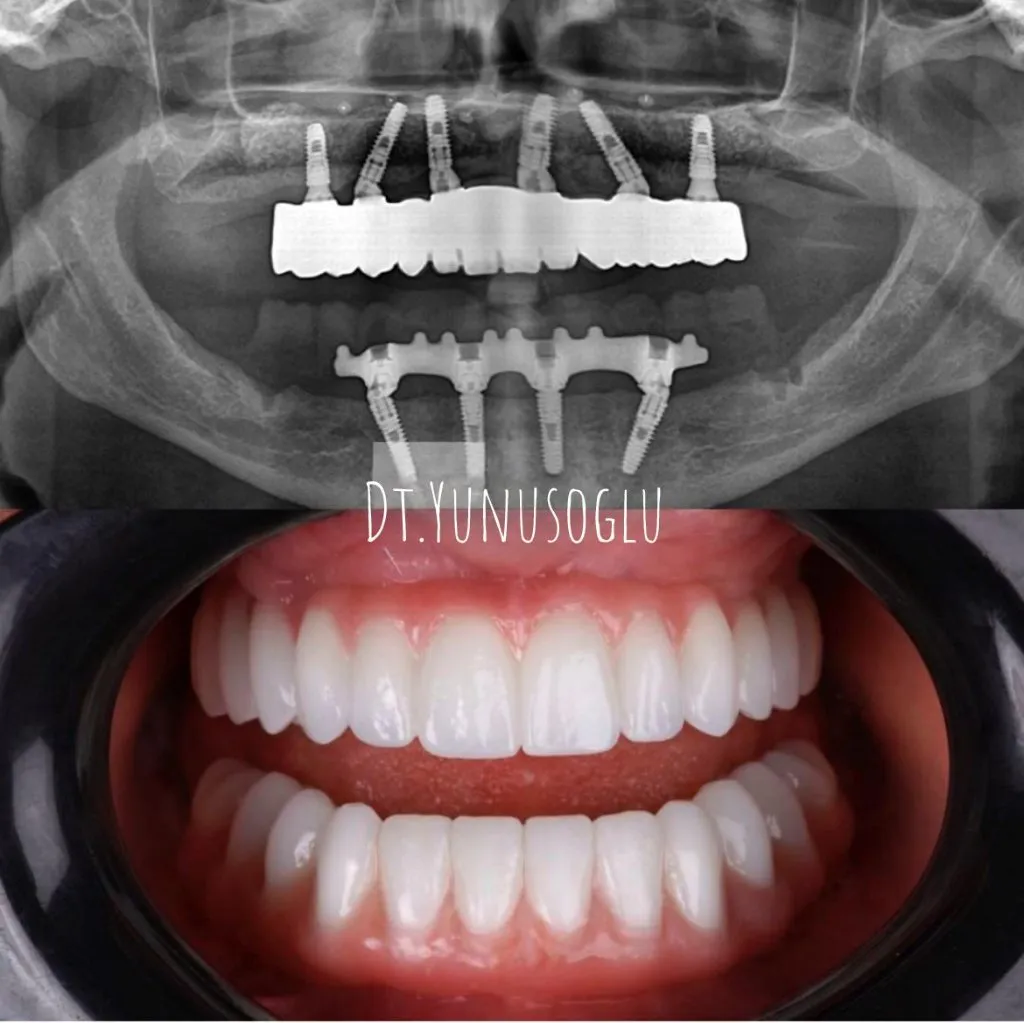
If you want teeth that never come out and feel closest to your own, All-on-4 is the stronger choice: a fixed bridge on four implants per jaw that only the dentist removes. If you prefer to take your teeth out to clean them, want fewer implants, or already manage well with a denture that just needs to stop moving, an implant-retained denture (a "snap-in" denture on two or more implants) is often the better fit, especially in the lower jaw. Both need the implants to heal for 2‑4 months, so both usually mean two trips. Send a panoramic X-ray or photos on WhatsApp +90 530 575 47 18 and the written plan arrives within 24 hours.
What is the difference, at a glance?
| Implant-retained denture | All-on-4 | |
|---|---|---|
| Fixed or removable | Removable by you; clicks onto attachments | Fixed; only the dentist removes it |
| Implants per jaw | Usually 2 in the lower jaw, more in the upper | 4 (sometimes 6) |
| Feel when eating | Stable, much better than a loose denture, slight movement possible | Closest to natural teeth |
| Cleaning | Taken out and brushed by hand; implants brushed in the mouth | Cleaned in the mouth with brushes and a water flosser, plus professional cleaning |
| Maintenance | Attachment inserts wear and are replaced from time to time | Regular checks and professional cleaning; screws and teeth occasionally need repair |
| Trips to Side | Usually two, with healing in between | Two: implants and a fixed temporary bridge first, final bridge after healing |
| Best for | Lower jaw, limited budget for implants, people who like to remove teeth at night | People who want fixed teeth and can clean around them daily |
What does the evidence say about a denture on two implants?
Quite a lot, and most of it is good news for the lower jaw. The 2009 York Consensus Statement, from the British Society for the Study of Prosthetic Dentistry, describes a lower denture on two implants as the first-choice standard of care for people with no lower teeth. A 2021 meta-analysis of 8 studies found that people with such a denture scored better than those with a conventional denture for satisfaction, comfort, speech and stability. The one area where it did not win was hygiene: attachments and implants add places to clean.
The upper jaw is different. An upper denture already holds better by suction, and when implants are used there, more of them are usually needed, often because the bone is softer. That is one reason why many people choose a fixed solution such as All-on-4 for the upper jaw and consider a snap-in denture mainly for the lower one.
What does the evidence say about All-on-4?
All-on-4 places four implants, the back two tilted, so that a full fixed bridge can often be anchored without bone grafting. An overview of 8 systematic reviews published in 2025 reported cumulative survival between 94.8% and 99.3%, and none of the reviews found All-on-4 inferior to designs with more implants; the authors also noted that much of the underlying research is of limited quality. A 2022 review of 11 studies with 693 patients aged 55 to 71 found high quality of life and satisfaction with All-on-4 bridges. Our All-on-4 guide covers candidacy and the timeline in detail.
How do cleaning and upkeep differ?
With a snap-in denture you take the teeth out, brush them over a basin, and brush the implant heads in your mouth. The small retentive inserts in the denture wear with use and are replaced from time to time; a 2017 systematic review of 33 studies concluded that this kind of maintenance is unavoidable but stays at an expected level with regular follow-up. For many older patients, and for anyone with stiff hands, being able to see and reach everything is a real advantage. More on this in dental implants for older adults.
An All-on-4 bridge stays in. You clean under and around it every day with interdental brushes and ideally a water flosser, and it is checked and professionally cleaned at regular intervals. People who keep that routine tend to be very happy with it; people who will not are better served by something they can take out.
How many trips and how long?
Implants need time to fuse with the bone: 2‑4 months, and up to 6 in the upper jaw, whichever option you choose. For All-on-4 the first visit takes about 5‑7 days: failing teeth are removed, the implants are placed and you leave with a fixed temporary bridge. The final bridge follows on the second trip. A snap-in denture also usually means two trips, and whether your existing or a new denture can be used in between is decided from your X-ray. What you wear while healing is explained in temporary teeth during treatment, and the exact days in how many days you need.
When is All-on-4 the wrong choice?
We place All-on-4 regularly, and it is still not right for everyone. It is the wrong choice if you will not be able to clean around a fixed bridge every day, if you would rather take your teeth out at night, or if your general health makes longer surgery a poor idea. Smoking and poorly controlled diabetes raise the risks for any implant; see implants with smoking, diabetes or gum disease. If you have only a few weak teeth left in one area, a smaller solution may make more sense: our comparison of implant, bridge or denture helps there, and not enough bone for implants covers the bone question.
When is a snap-in denture the wrong choice?
If your main wish is teeth that feel completely fixed, a removable denture will disappoint you, however stable it is. It is also a weaker choice if you are not willing to have inserts replaced from time to time, or if the upper jaw would need so many implants that a fixed bridge becomes the more sensible design. If your denture simply broke on holiday, read broken denture on holiday first: implants are a plan for the next months, not a same-week fix.
How do you decide?
Start with an X-ray. A panoramic X-ray shows how much bone you have in each jaw, and with photos of your current denture and a short note on what bothers you most, the dentist can tell you which options fit. The written plan arrives within 24 hours and compares the realistic choices for your case. Implants placed at our clinic carry a written 10-year guarantee; what follow-up looks like once you are home is in after you fly home. Send your X-ray on WhatsApp, read more on dental implants, or use the contact page.
Frequently Asked Questions
What is an implant-retained denture?
A removable denture that clicks onto attachments on two or more implants, so it stays in place when you eat and speak. You still take it out to clean it. In the lower jaw, two implants are often enough.
Is All-on-4 better than a snap-in denture?
Not better for everyone, but different. All-on-4 is fixed and feels closest to natural teeth; a snap-in denture needs fewer implants and is easier to clean because it comes out. The right choice depends on your bone, your health and whether you want fixed or removable teeth.
How many implants does a snap-in denture need?
In the lower jaw, usually two; the York Consensus Statement describes a lower denture on two implants as the first-choice standard of care. In the upper jaw more implants are usually needed. Your X-ray decides.
Which is easier to clean?
The snap-in denture, because you take it out and can see and reach everything. An All-on-4 bridge is cleaned in the mouth with interdental brushes and a water flosser, plus professional cleaning at regular checks.
How long do All-on-4 implants last?
An overview of 8 systematic reviews reported cumulative survival of 94.8% to 99.3% for All-on-4, with no review finding it inferior to designs with more implants. Implants at our clinic carry a written 10-year guarantee.
How many trips to Side do I need?
Usually two for either option, because implants need 2‑4 months to heal, up to 6 in the upper jaw. For All-on-4 the first visit takes about 5‑7 days and you leave with a fixed temporary bridge.
Can I switch from a snap-in denture to a fixed bridge later?
Sometimes, if more implants can be added where there is enough bone. Planning for it from the start is easier than changing course later, so mention it when you send your X-ray to WhatsApp +90 530 575 47 18.
Sources
- Thomason et al. (2009), Br Dent J: Mandibular two implant-supported overdentures as the first choice standard of care for edentulous patients, the York Consensus Statement
- Egido Moreno et al. (2021), Clin Exp Dent Res: Quality of life and satisfaction with complete dentures versus mandibular overdentures, systematic review and meta-analysis
- Figueiredo et al. (2025), Oral Maxillofac Surg: Rehabilitation of edentulous jaws using the All-on-Four treatment concept, an overview of systematic reviews
- Gonçalves et al. (2022), Clin Oral Investig: Oral health-related quality of life and satisfaction with all-on-four full dentures, systematic review
- Assaf et al. (2017), J Prosthet Dent: Prosthetic maintenance of different mandibular implant overdentures, systematic review